


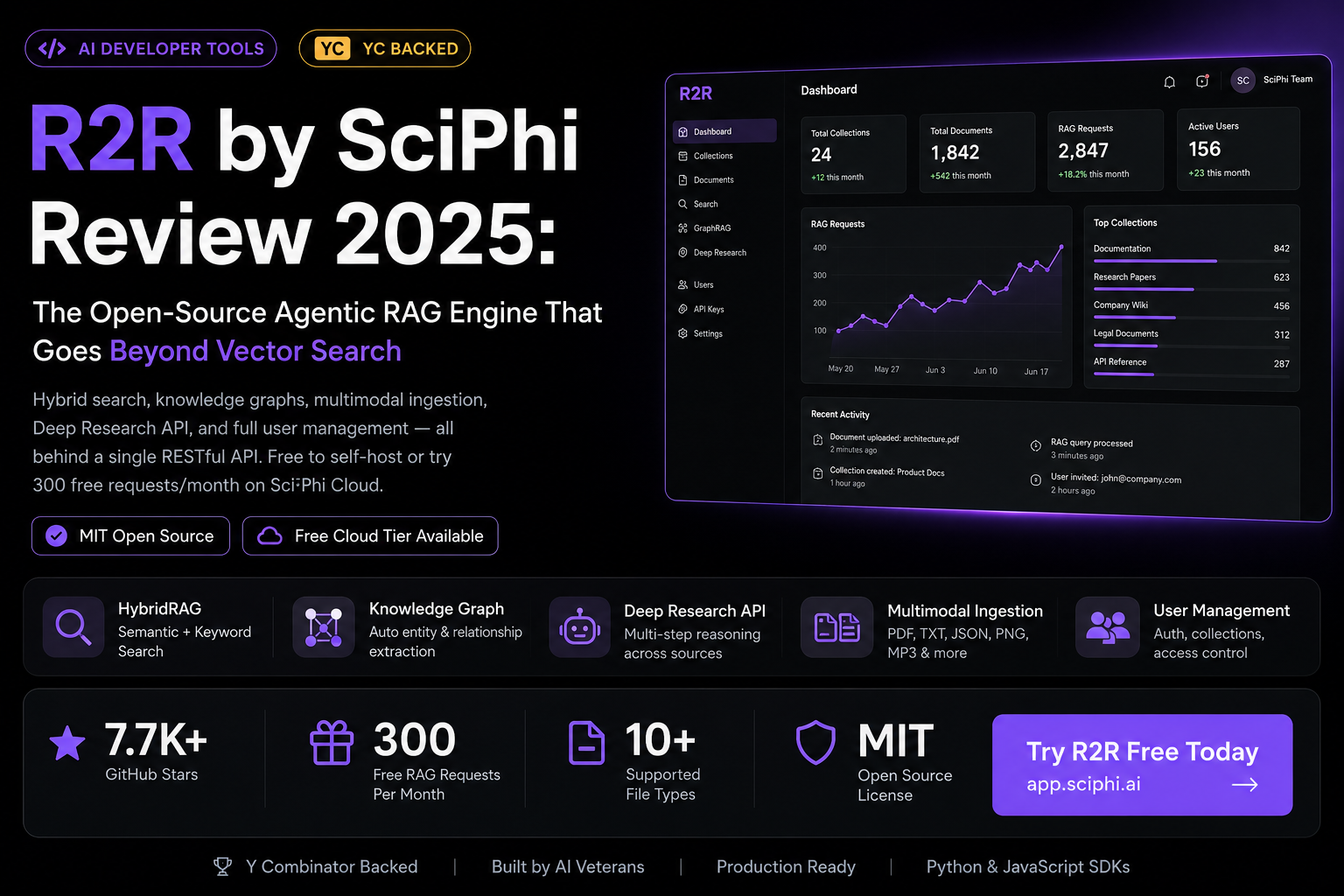
R2R by SciPhi Review 2025: The Open-Source Agentic RAG Engine That Goes Beyond Vector Search — With 7,700+ GitHub Stars and YC Backing
Built by a team of AI veterans and backed by Y Combinator, R2R is the production-ready RAG system that combines hybrid search, knowledge graphs, multimodal ingestion, and a Deep Research API — all behind a single RESTful API. Free to self-host, cloud tier available.
Most RAG implementations share the same fundamental limitation: they match a query to the most similar chunks of text and call it retrieval. That works for simple Q&A over small document sets. It breaks down the moment you need to synthesize information across dozens of documents, reason through conflicting sources, trace connections between entities, or answer complex questions that require multiple retrieval steps. R2R was built to solve exactly that — not just retrieval, but agentic retrieval.
R2R (Retrieval to Response) is an open-source production-ready RAG engine built by the team at SciPhi — Y Combinator alumni who spent years building RAG systems in production before open-sourcing the infrastructure they wished had existed. With 7,700+ GitHub stars, an active MIT-licensed codebase, Python and JavaScript SDKs, a Next.js dashboard, a managed cloud at app.sciphi.ai, and a Deep Research API that orchestrates multi-step reasoning across your documents and the web, R2R is the most complete standalone RAG platform available today.
What Is R2R?
R2R is an open-source, API-first RAG (Retrieval-Augmented Generation) engine that goes well beyond basic vector search to deliver what its creators call "truly agentic retrieval." At its core, R2R provides a complete pipeline for ingesting documents (PDF, TXT, JSON, PNG, MP3, and more), chunking and embedding them, storing embeddings in PostgreSQL with pgvector, and serving retrieval via a RESTful API with Python and JavaScript SDKs. On top of that foundation, R2R adds HybridRAG — a combination of semantic vector search and keyword BM25 search with reciprocal rank fusion for higher accuracy — automatic knowledge graph construction that extracts entities and relationships from your documents for GraphRAG queries, a full user authentication and collection management system, and the Deep Research API — an agentic multi-step reasoning system that iteratively fetches from your knowledge base and the web to deliver synthesized, cited answers for complex queries.
It runs locally in minutes with pip install r2r, deploys via Docker Compose for production, and is available as a managed cloud at app.sciphi.ai with a generous free tier. The SciPhi team describes the architecture as "R2R is to LangChain what Next.js is to React" — an opinionated, production-ready engine that gives you a complete RAG stack out of the box, rather than a collection of building blocks you assemble yourself.
Key Features
HybridRAG (Semantic + Keyword Search)
Combines semantic vector search with BM25 keyword retrieval using reciprocal rank fusion — giving you the precision of keyword matching and the contextual depth of semantic search in every query. Consistently outperforms pure vector search on accuracy benchmarks. No configuration tuning required — it works out of the box with any document set.
Automatic Knowledge Graph (GraphRAG)
Automatically extracts entities and relationships from ingested documents to build a knowledge graph. Query it via GraphRAG to surface connections between concepts that pure vector search misses — powered by SciPhi's Triplex model for cost-effective graph construction. Find hidden relationships in your documents that chunk-level retrieval would never surface.
Deep Research API
An agentic multi-step reasoning system that formulates sub-queries, retrieves from your knowledge base and the web iteratively, synthesizes information across sources, and returns fully cited answers — the equivalent of a research agent embedded directly in your RAG pipeline. Designed for complex questions that span multiple documents and require reasoning across sources.
Multimodal Ingestion
Ingest .txt, .pdf, .json, .png, .mp3, and more. PDFs are parsed with layout awareness; audio is transcribed via Whisper; images are described with multimodal models. A single ingestion pipeline handles your entire document estate — no separate tools for different file types. Everything flows into the same embedding and retrieval system.
Pricing Plans
| Plan | Price | What's Included |
|---|---|---|
| Self-Hosted (Open Source) | Free forever — MIT license | Full R2R stack: API server, Next.js dashboard, PostgreSQL + pgvector, graph clustering — deploy via Docker Compose or Railway. You pay your own LLM provider API costs separately. |
| SciPhi Cloud Free Tier | Free | 300 RAG requests/month. No credit card required — app.sciphi.ai. Managed hosting, no infrastructure to manage. You pay your own LLM provider API costs. |
| SciPhi Cloud Paid | Custom pricing | Higher request volumes, enterprise SLA, dedicated support — contact SciPhi sales. You pay your own LLM provider API costs. |
| Enterprise | Custom | On-prem deployment, SSO, RBAC, compliance, dedicated engineering support. Full infrastructure control with SciPhi's engineering team. |
Note: Self-hosting on Railway costs approximately $5–20/month in infrastructure depending on volume. You pay your own LLM provider API costs (OpenAI, Anthropic, etc.) separately — R2R does not add markup.
Try R2R Free on SciPhi Cloud →Pros & Cons
✓ What Works
- ✅ HybridRAG — semantic + keyword search with reciprocal rank fusion outperforms pure vector search out of the box
- ✅ Deep Research API — multi-step agentic retrieval that synthesizes across documents and the web with citations
- ✅ Free cloud tier (300 requests/month) with no credit card — lowest friction entry point in the RAG platform category
- ✅ Full user and collection management built in — production-grade auth, multi-tenancy, and access control without building it yourself
- ✅ YC-backed team with proven track record — SciPhi has shipped consistently since their Show HN launch in 2024
✗ What Holds It Back
- ❌ Setup complexity — early HN feedback flagged multi-repo setup (API + separate dashboard repo) as confusing; Docker Compose deployment requires DevOps familiarity
- ❌ Python 3.10–3.12 only — Python 3.13+ not yet supported as of v3.6.6
- ❌ Knowledge graph construction can be resource-intensive at scale — graph clustering requires a separate service and adds infrastructure overhead
- ❌ Active development means occasional breaking changes between minor versions — monitor release notes carefully in production
💡 Community Feedback: What Developers Say
How It Compares to Alternatives
| Feature | R2R | LangChain | LlamaIndex |
|---|---|---|---|
| Architecture | API-first engine | Framework/library | Framework/library |
| HybridRAG Built-In | YES out of the box | MANUAL configure | MANUAL configure |
| Knowledge Graph | YES auto-extraction | PARTIAL (LangGraph) | PARTIAL |
| Deep Research API | YES multi-step agent | NO | NO |
| User Management | YES built-in | NO | NO |
| Multimodal Ingestion | YES — 10+ file types | PARTIAL | PARTIAL |
The comparison table makes R2R's positioning clear: this is not a framework — it's a complete engine. LangChain and LlamaIndex are collections of building blocks that skilled developers assemble into a RAG pipeline. R2R is an opinionated, production-ready system where ingestion, search, RAG, knowledge graphs, user management, and the Deep Research API are all features you turn on, not components you build. The tradeoff is flexibility: LangChain gives you infinite composability, while R2R gives you a complete stack that works out of the box. For teams that want to ship a production RAG application in days rather than weeks, R2R's opinionated architecture is the right choice. For teams that need to build highly custom retrieval logic from scratch, LangChain's building blocks remain the better foundation.
Who Should Use R2R?
Best For: Python and full-stack developers building production RAG applications that need to go beyond basic vector search — enterprise knowledge bases, document Q&A systems, research assistants, legal document analysis, compliance tools, and any application where answer accuracy and citation tracing matter. Teams who want a complete, opinionated RAG infrastructure (ingestion → retrieval → generation → user management) without stitching together LangChain, a vector DB, a graph DB, and a custom API layer separately. YC-backed startups and enterprise teams who value the SciPhi team's responsiveness and the trust they've built with production customers.
Consider Alternatives If: You need a no-code RAG builder — Flowise or Dify provide visual builders with lower technical overhead. You're deeply invested in LangChain's ecosystem and want to reuse existing LangChain agents and tools — LangChain's LCEL pipelines may be more familiar. You only need simple vector search for small document sets — plain pgvector + an LLM SDK is cheaper and simpler. You need real-time streaming RAG responses at very high concurrency — evaluate managed vector databases like Pinecone or Weaviate paired with custom API layers. Your team has limited DevOps experience and needs a fully managed, zero-configuration solution.
Expert Editorial Opinion
R2R solves a problem that becomes obvious the moment you try to deploy a RAG system in production: basic vector search is not enough. Matching a query to the top-k most similar chunks works in demos. It falls apart when users ask questions that span multiple documents, require entity relationship reasoning, or need multi-step synthesis. R2R's HybridRAG, GraphRAG, and Deep Research API are direct, practical answers to each of these failure modes — and the fact that they're all accessible via a single RESTful API means you don't have to build the orchestration layer yourself.
The Hacker News feedback on R2R V2 (July 2024) is instructive. The community praised the vision and the technical depth but flagged the setup experience — multiple repos, unclear Docker configuration, and the question of whether R2R was an SDK or a suite of apps. The SciPhi team responded constructively and has spent the months since shipping a cleaner Docker Compose setup, a Railway deployment template, and a unified cloud at app.sciphi.ai. The product has matured significantly since those early feedback threads, and v3.6.x is meaningfully more production-ready than v2.
The YC backing is not just a signal of investor confidence — it's a signal of the team's approach. Y Combinator backed SciPhi specifically on the Deep Research API thesis: that truly agentic RAG, which reasons iteratively rather than retrieving once and answering, is the correct architecture for enterprise knowledge applications. The trajectory from the February 2024 Show HN post (basic RAG framework) to the 2025 Deep Research API launch (agentic multi-step reasoning across documents and the web) shows a team that listens to developers and builds toward the right long-term architecture. For teams building serious RAG infrastructure, R2R is the most complete open-source option available today.
Final Verdict
R2R by SciPhi is the best open-source production RAG engine available for Python developers who need to go beyond basic vector search. HybridRAG, GraphRAG, multimodal ingestion, the Deep Research API, and built-in user management give you a complete, opinionated RAG infrastructure that would take weeks to assemble from scratch using lower-level libraries. The free cloud tier at app.sciphi.ai and MIT-licensed self-hosting option make it zero-risk to evaluate. The setup complexity and active development pace require some DevOps comfort. For engineering teams building serious RAG applications, this is a 9.0 out of 10.
🔗 Related ToolRadar Reviews
More tools from AI Developer Tools
- Can an AI Agent Really Browse the Web for You?
- I Built an AI Agent Army Without Writing Code
- This AI Agent Works While You Sleep — Here's How
- I Gave AI a 47-Page Spec and Watched It Build
- The Search Engine Built for AI Agents
- I Replaced My Brittle Playwright Scripts With Something Better
- Is Aider the Best Free AI Coding Assistant?
- Can an AI Agent Really Replace Your Entire Team?
❓ Frequently Asked Questions
What would your knowledge base answer if it could reason across every document you own — and the entire web?
Most RAG systems find chunks. R2R finds answers. The difference between a system that retrieves text and one that reasons across sources is the difference between a search engine and a research assistant. R2R gives you the research assistant — and it's free to try.

Comments
Post a Comment