



Promptfoo Review 2026: The Open-Source CLI OpenAI Bought to Stress-Test Every LLM Prompt
300K+ developers, 156 Fortune 500 companies, 50+ vulnerability types, and a $0 price tag. Is Promptfoo the last free tool your LLM pipeline actually needs?
- What Is Promptfoo and Why Did OpenAI Buy It?
- Core Features: From YAML Configs to Automated Red Teaming
- Pricing Breakdown: Free Forever vs Cloud Platform
- Pros & Cons: Where Promptfoo Excels and Frustrates
- Community Feedback: What Engineers Actually Say
- Promptfoo vs Langfuse vs Arize Phoenix: The 2026 Comparison
- Who Should Use Promptfoo — and Who Should Skip It
- Expert Editorial Opinion
- Final Verdict
- Related ToolRadar Reviews
- Frequently Asked Questions
Here is the scenario that keeps AI product managers awake at night: your LLM application ships a prompt update on Tuesday, everything looks fine in staging, and by Wednesday afternoon your support queue is flooded with users reporting bizarre outputs, leaked system instructions, or worse — jailbroken responses that your compliance team has to explain to legal. The root cause is almost always the same: nobody systematically tested the new prompt against a structured set of inputs, edge cases, and adversarial attacks before it went live. Promptfoo, an open-source CLI founded by Ian Webster in San Francisco, exists to make that scenario impossible.
Originally built for LLM apps serving over 10 million users in production, Promptfoo has grown into the leading open-source framework for LLM testing, evaluation, and red teaming. More than 300,000 developers use it, 156 of the Fortune 500 have integrated it into their AI development lifecycle, and in March 2026 — just three years after its Show HN launch — OpenAI acquired the project. Updated July 2026, this review examines whether Promptfoo's YAML-based testing discipline is the missing piece in your LLM pipeline, or whether its pre-deployment-only scope leaves a gap that observability tools like Langfuse and Arize Phoenix must fill.
What Is Promptfoo and Why Did OpenAI Buy It?
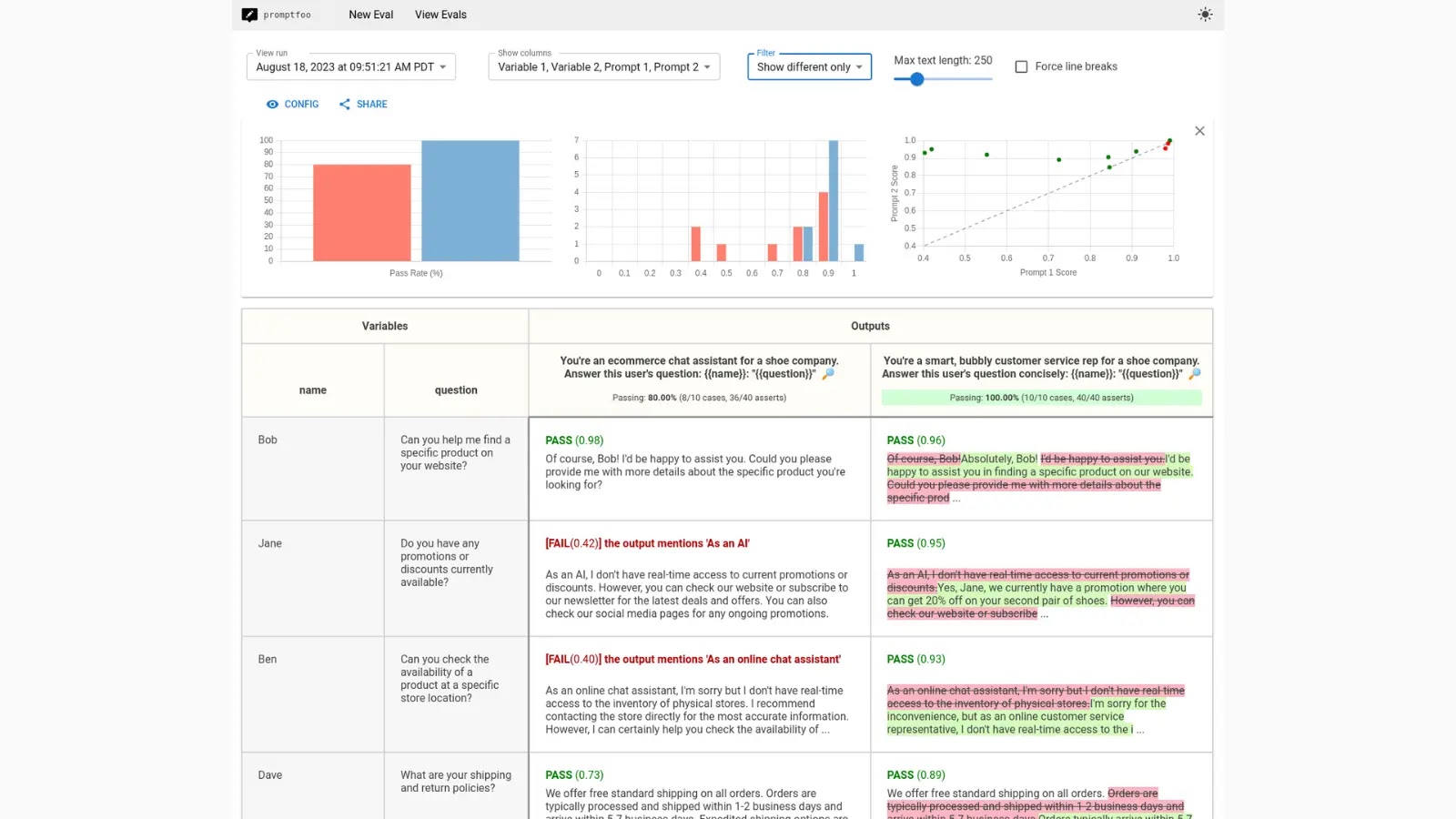
Promptfoo is an open-source CLI and library for testing, evaluating, and red-teaming LLM applications. Its core philosophy is simple but radical: instead of manually eyeballing outputs across a handful of test inputs, you define what "good" looks like in a YAML configuration file, pick your models, and Promptfoo runs every combination automatically — testing every prompt against every model for every test case and scoring the results. This turns prompt evaluation from an art into an engineering discipline.
The tool was originally built to solve a very specific pain point: Ian Webster was tuning many prompts for a production LLM app and had no systematic way to compare them. The CLI outputs "before" and "after" results side by side, making regressions immediately visible. Over time, the scope expanded to cover automated red teaming (50+ vulnerability types from prompt injection to jailbreaks), multi-model benchmarking (GPT-4o vs Claude vs Llama in a single command), RAG faithfulness evaluation, latency threshold testing, cost-per-run validation, and golden dataset comparison.
OpenAI's acquisition in March 2026 signals something important about the maturity of the AI tooling market. Rather than building its own testing framework from scratch, OpenAI bought the tool that 300,000 developers had already validated. The co-founder confirmed on Hacker News that the repo stays public under the same MIT License, multiple providers remain supported, and the team continues reviewing PRs and cutting releases. For users, this means the backing of a major AI lab without the lock-in of a proprietary tool.
Core Features: From YAML Configs to Automated Red Teaming
YAML-Based Test Configuration
Define test cases, assertions, and model providers in simple YAML files — no programming required for basic usage. Custom assertion logic extends with JavaScript or Python when you need it. Live reloads and caching make iteration fast and developer-friendly.
Multi-Model Benchmarking
Test the same prompt across OpenAI, Anthropic Claude, Google Gemini, Azure OpenAI, AWS Bedrock, local models via Ollama, and any OpenAI-compatible provider — all simultaneously. Compare output quality, latency, and cost side by side in a single run.
Automated Red Teaming
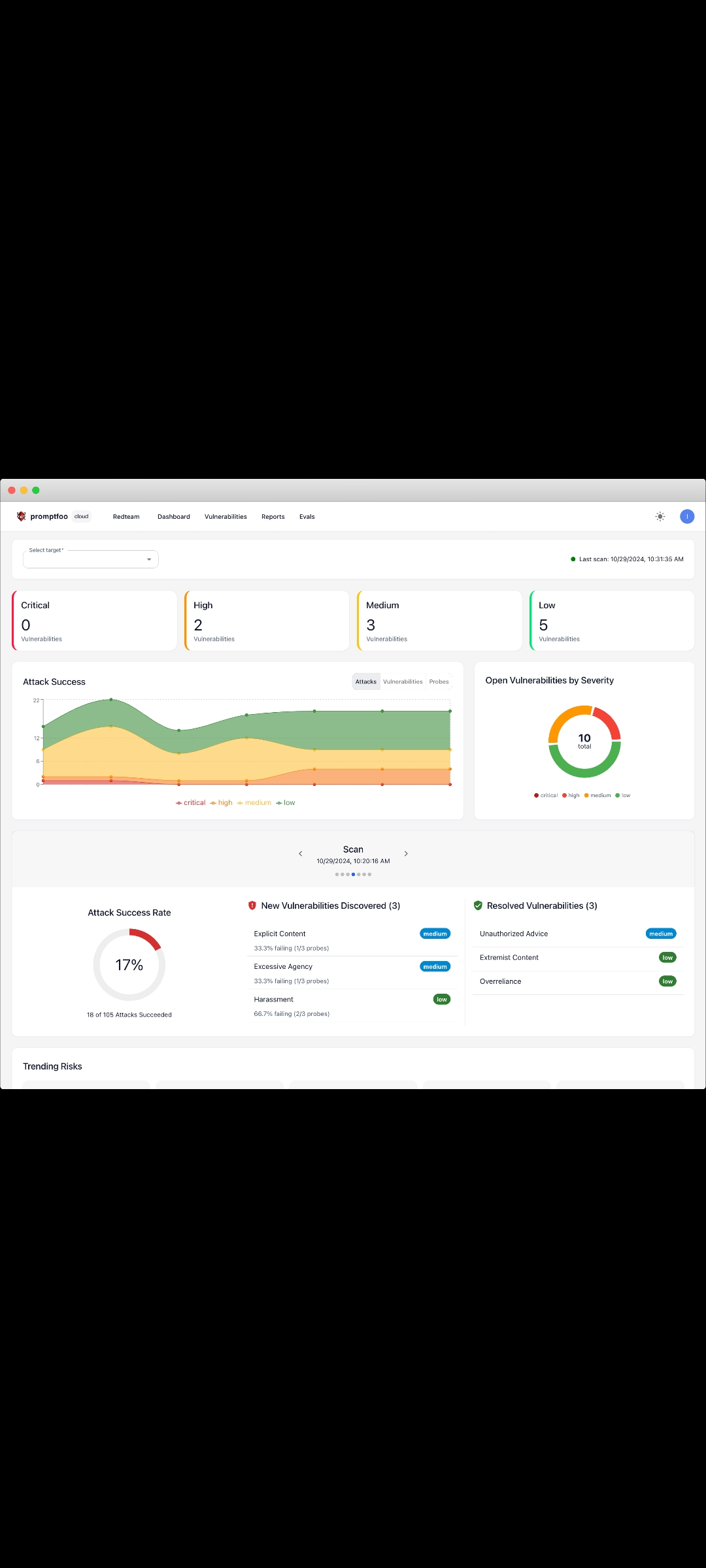
Covers 50+ vulnerability types from prompt injection to jailbreaks, with no manual scenario writing required. The open-source Community version includes up to 10,000 red-team probes per month at no charge. Continuous testing in CI/CD scales from 1 to 100+ applications.
RAG Faithfulness & Regression Testing
Validate that your retrieval-augmented generation pipeline returns faithful, grounded responses. Golden dataset comparison catches silent regressions across prompt iterations that human reviewers would completely miss over dozens of silent updates.
Latency & Cost Threshold Testing
Set hard limits on response time and cost-per-run. Promptfoo fails tests that exceed your thresholds, ensuring your LLM application stays within budget and SLA constraints before it ever reaches production.
Universal Provider Support
Native integration with 15+ LLM providers and counting. The OpenAI acquisition has not reduced provider diversity — Claude, Gemini, local Ollama models, and custom endpoints all remain fully supported and actively maintained.
Pricing Breakdown: Free Forever vs Cloud Platform
| Plan | Cost | What's Included |
|---|---|---|
| Community (Open Source) | $0 (MIT License) | Full CLI with all features, no restrictions, self-hosted, up to 10K red-team probes/month, community support via GitHub |
| Cloud (Individual) | $0 free tier | Web UI, cloud-hosted test runs, basic collaboration, historical results, shareable reports |
| Cloud (Team) | $50/month + API costs | Team collaboration, advanced permissions, CI/CD integrations, priority support, unlimited test runs |
| Enterprise | Custom pricing | SSO, dedicated support, custom SLAs, on-premise deployment options, advanced security features, unlimited red-team probes |
The pricing model is one of Promptfoo's strongest selling points. The core tool is genuinely free and open-source under the MIT License, with no feature restrictions or usage caps on the CLI. You can run unlimited tests, benchmark unlimited models, and deploy red-team probes up to 10,000 per month without paying a cent. The only costs you incur are the LLM API tokens consumed during evaluations — and even those can be minimized by testing against cheaper models or local Ollama instances first.
The Cloud platform adds convenience — a web UI for non-technical stakeholders, cloud-hosted test runs that do not drain your local machine, and team collaboration features. At $50 per month for team features plus API costs, it is aggressively priced compared to enterprise observability platforms that charge thousands per month. For teams that need SSO, on-premise deployment, or unlimited red-team probes, Enterprise pricing is customized. The bottom line: Promptfoo is accessible to solo developers and Fortune 500 companies alike.
Pros & Cons: Where Promptfoo Excels and Frustrates
✓ What Promptfoo Gets Right
- ✅ Completely free and open-source (MIT License) with zero feature restrictions
- ✅ YAML-based config makes test suites version-controlled and reproducible
- ✅ 50+ automated vulnerability types for red teaming without manual scenario writing
- ✅ Side-by-side multi-model comparison across 15+ providers in a single command
- ✅ Strong CI/CD integration turns prompt testing into a genuine deployment gate
- ✅ OpenAI acquisition adds credibility without reducing provider diversity
✗ Where It Falls Short
- ❌ No production observability — zero live monitoring, alerting, or traffic tracing
- ❌ Web UI is functional but not polished compared to commercial alternatives
- ❌ Hard Node.js dependency does not fit every team's technology stack
- ❌ Learning curve for setting up assertion types and custom evaluators
- ❌ Multi-turn conversation testing with state requires careful YAML structuring
💡 Community Feedback: What Engineers Actually Say
Promptfoo vs Langfuse vs Arize Phoenix: The 2026 Comparison
| Feature | Promptfoo | Langfuse | Arize Phoenix |
|---|---|---|---|
| Primary Purpose | Pre-deployment testing & red teaming | Production observability & tracing | Model evaluation & drift detection |
| Pricing (Core) | $0 (MIT open source) | $0 (open source) + cloud tiers | $0 (open source) + cloud tiers |
| Red Teaming | 50+ vulnerability types, automated | Limited — not a core feature | Limited — not a core feature |
| Production Monitoring | None — pre-deployment only | Real-time tracing, cost analytics, alerts | Deep drift detection, model performance |
| Multi-Model Benchmarking | 15+ providers, side-by-side | Via integrations, not native | Via integrations, not native |
| CI/CD Integration | Native, first-class support | Good, but post-deployment focused | Good, evaluation-focused |
| Setup Complexity | YAML configs, moderate learning curve | Quick SDK integration | Steeper, enterprise-oriented |
| Best For | CI/CD gating, red teaming, prompt regression | Live app monitoring, cost tracking | Enterprise ML evaluation, drift detection |
The comparison reveals a critical truth about the LLM tooling landscape in 2026: these tools are not competitors — they are complements. Promptfoo catches broken prompts and security vulnerabilities before they ship. Langfuse traces and monitors live traffic, alerting you when production behavior degrades. Arize Phoenix dives deep into model evaluation and drift detection for enterprise ML teams. A mature AI product pipeline needs Promptfoo at the CI/CD gate, Langfuse in production, and potentially Arize for long-term model health. Choosing one over the others is like choosing between a compiler and a debugger — they solve different problems at different stages of the lifecycle.
Who Should Use Promptfoo — and Who Should Skip It
Ideal users: Engineering teams building LLM-powered products that need systematic prompt testing before every deployment. AI startups shipping frequent prompt updates who cannot afford regression surprises. Security-conscious enterprises running red-team exercises against their AI applications. Teams that want multi-model benchmarking without writing custom evaluation scripts. Developers who prefer version-controlled YAML configs over clicking through web UIs. Any team that has ever shipped a prompt update and discovered a regression only after users complained.
Look elsewhere if: You need production observability, real-time alerting, or traffic tracing — Promptfoo explicitly does not do this, and tools like Langfuse or LangSmith are purpose-built for that. If your team has zero YAML or command-line comfort, the learning curve may frustrate more than it helps. If you need polished stakeholder dashboards out of the box, commercial platforms offer better visualizations. If you are testing complex multi-turn conversations with heavy state management, the YAML structuring required may become unwieldy. And if your stack cannot accommodate Node.js, you will need to look for Python-native alternatives.
Expert Editorial Opinion
Promptfoo represents something rare in the AI tooling space: a genuinely free, genuinely powerful tool that solves a real problem without upsell pressure. The MIT License means you can self-host it forever, audit every line of code, and fork it if the OpenAI acquisition ever changes direction. That the co-founder publicly committed to maintaining open-source support for all providers — including OpenAI's competitors — on Hacker News adds a layer of trust that proprietary tools simply cannot match.
The pricing gap between Promptfoo and commercial alternatives is staggering. At $0 for the core tool versus thousands per month for enterprise observability platforms, Promptfoo removes the financial barrier that keeps many teams from adopting systematic prompt testing. The $50 per month Cloud tier is almost an afterthought — a convenience layer for teams that want a web UI without the infrastructure overhead of self-hosting. For solo developers and early-stage startups, this accessibility is transformative. A one-person team can run the same red-team probes that a Fortune 500 security team runs, with the same tooling.
But the pre-deployment-only scope is a deliberate and important limitation. Promptfoo will not tell you that your production model is drifting, that your costs are spiking, or that users are encountering edge cases your test suite missed. It is a gatekeeper, not a guardian. Teams that treat Promptfoo as their only AI quality tool are making a mistake. The correct architecture is Promptfoo in CI/CD, Langfuse or Arize in production, and human review for the cases neither tool catches. This multi-layer approach is what separates teams that ship reliable AI products from teams that ship AI products and hope for the best.
The OpenAI acquisition raises interesting strategic questions. On one hand, it validates Promptfoo's approach and likely accelerates development with additional resources. On the other hand, it creates a perception risk — will the tool remain neutral across providers, or will OpenAI-specific features receive preferential treatment? The founder's public commitments and the continued support for Claude, Gemini, and local models suggest the neutrality is real, but teams should monitor this dynamic as the integration deepens.
One final consideration: the Node.js dependency is a genuine friction point for Python-native ML teams. While the YAML config abstracts much of the implementation detail, teams that cannot or will not install Node.js in their environment will find the barrier to entry higher than it needs to be. A Python-native rewrite or wrapper would dramatically expand Promptfoo's addressable market, though the current JavaScript/TypeScript implementation is well-suited for the web-focused teams that make up much of its user base.
Final Verdict

Promptfoo earns an 8.7 out of 10 for its exceptional value proposition — a genuinely free, MIT-licensed tool that brings enterprise-grade prompt testing and red teaming to teams of any size. The YAML-based configuration, 50+ automated vulnerability types, and side-by-side multi-model benchmarking are best-in-class for pre-deployment validation. The 0.3-point deduction comes from the lack of production observability (by design, but still a gap), the functional-but-unpolished Web UI, the Node.js dependency that excludes some stacks, and the learning curve for custom assertions. For any team shipping LLM-powered products, Promptfoo belongs in your CI/CD pipeline. It will not replace your observability stack, but it will catch the regressions and vulnerabilities that observability tools discover too late.
🔗 Related ToolRadar Reviews
More tools from AI Security & Infrastructure
- Your AI Agents Have Security Holes — This Tool Fixes Them
- The Search Engine Built for AI Agents
- Can an AI Agent Really Browse the Web for You in 2026?
- I Gave an AI Agent Full Control of My Workflow — Here's What Happened
- This AI Agent Replaced My Entire Team's Manual Work
- I Built an AI Agent Army Without Writing a Single Line of Code
- Can an AI Agent Really Replace Your Entire Backend?
- I Replaced My Operations Team With an AI Agent — Here's the Real Cost
❓ Frequently Asked Questions
When was the last time you shipped a prompt update without testing it against a single adversarial input?
The teams that sleep well at night are not the ones with the best models — they are the ones with the best test suites.

Comments
Post a Comment