


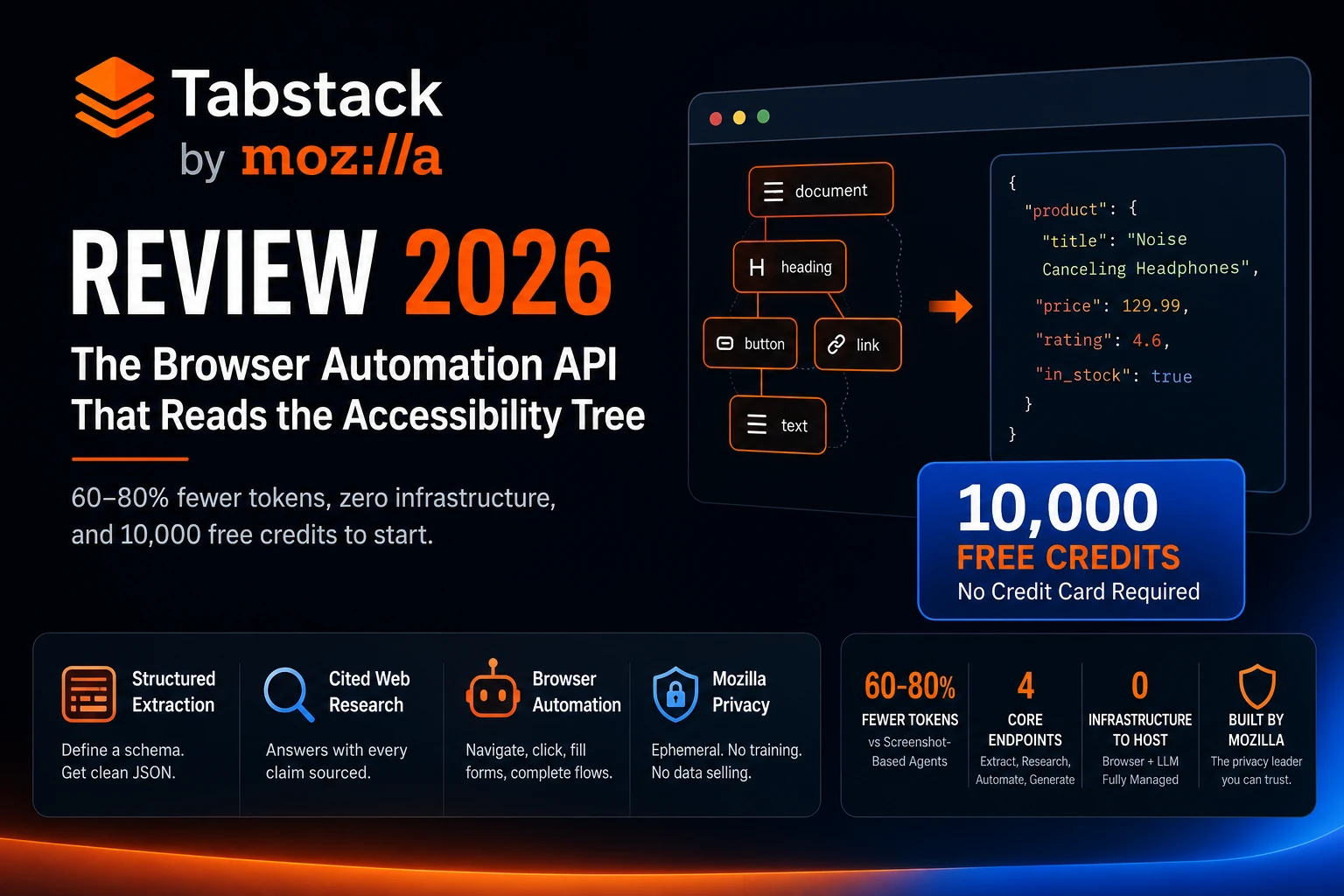
Tabstack by Mozilla Review 2026: The Browser Automation API That Reads the Accessibility Tree
Built by Mozilla with 10,000 free credits to start — Tabstack is the web execution layer for AI agents and developers who need structured data extraction, cited multi-source research, and full browser automation without running a single headless browser, wiring in an LLM, or maintaining brittle scraper scripts.
Every developer who has tried to add live web data to an AI agent knows how the story goes: you start with a simple fetch, it breaks because the page is JavaScript-rendered, you add Puppeteer, then you need proxies, then the selectors break when the site redesigns, then you are maintaining a browser farm instead of building your product. That maintenance tail never shows up in the estimate and never stops. Tabstack was built to eliminate it entirely — not by building a better scraper, but by treating web browsing as distinct infrastructure and solving it properly.
Tabstack is Mozilla's browser infrastructure platform for AI agents — a REST API with TypeScript and Python SDKs, an MCP server, a CLI, and an open-source self-host library (Pilo). Launched publicly in April 2026 with its most recent Dev Tools update on June 18, 2026, Tabstack provides four capabilities behind one unified credit system: structured data extraction to a developer-defined JSON schema, Markdown conversion of any page for RAG pipelines, cited multi-source web research that answers questions with every claim sourced, and full browser automation — navigate, click, fill forms, complete multi-step flows on JavaScript-heavy pages you do not control. The architecture that sets it apart: instead of taking a full-page screenshot on every action (burning thousands of vision tokens), Tabstack reads the accessibility tree — cutting token consumption 60–80% at scale.
What Is Tabstack?
Tabstack is a web execution and data transformation API built at Mozilla that gives AI agents and developers finished output from the live web in a single API call — without provisioning a browser, wiring in an LLM, or managing a scraping stack. The platform is built around four unified endpoints: /extract for structured JSON extraction to any developer-defined schema (enforced on every call, even when the source page changes), /generate for Markdown page conversion optimized for LLM ingestion and RAG pipelines, /research for cited multi-source web research where source selection, reading, synthesis, and citation all happen inside the call, and /automate for full browser automation — navigating, clicking, filling forms, completing multi-step flows on pages you do not control. The browser and the model both run on Tabstack's infrastructure. You make one call. The accessibility tree architecture (rather than screenshot-based vision) means every action costs 60–80% fewer tokens than competing browser agents — a meaningful cost difference at production scale. Mozilla-documented data practices apply: requests are ephemeral, data is never sold, and nothing is used to train models. Tabstack also ships Pilo — an open-source browser automation library on GitHub (mozilla/pilo) for developers who want to self-host.
Key Features
Schema-First Structured Extraction
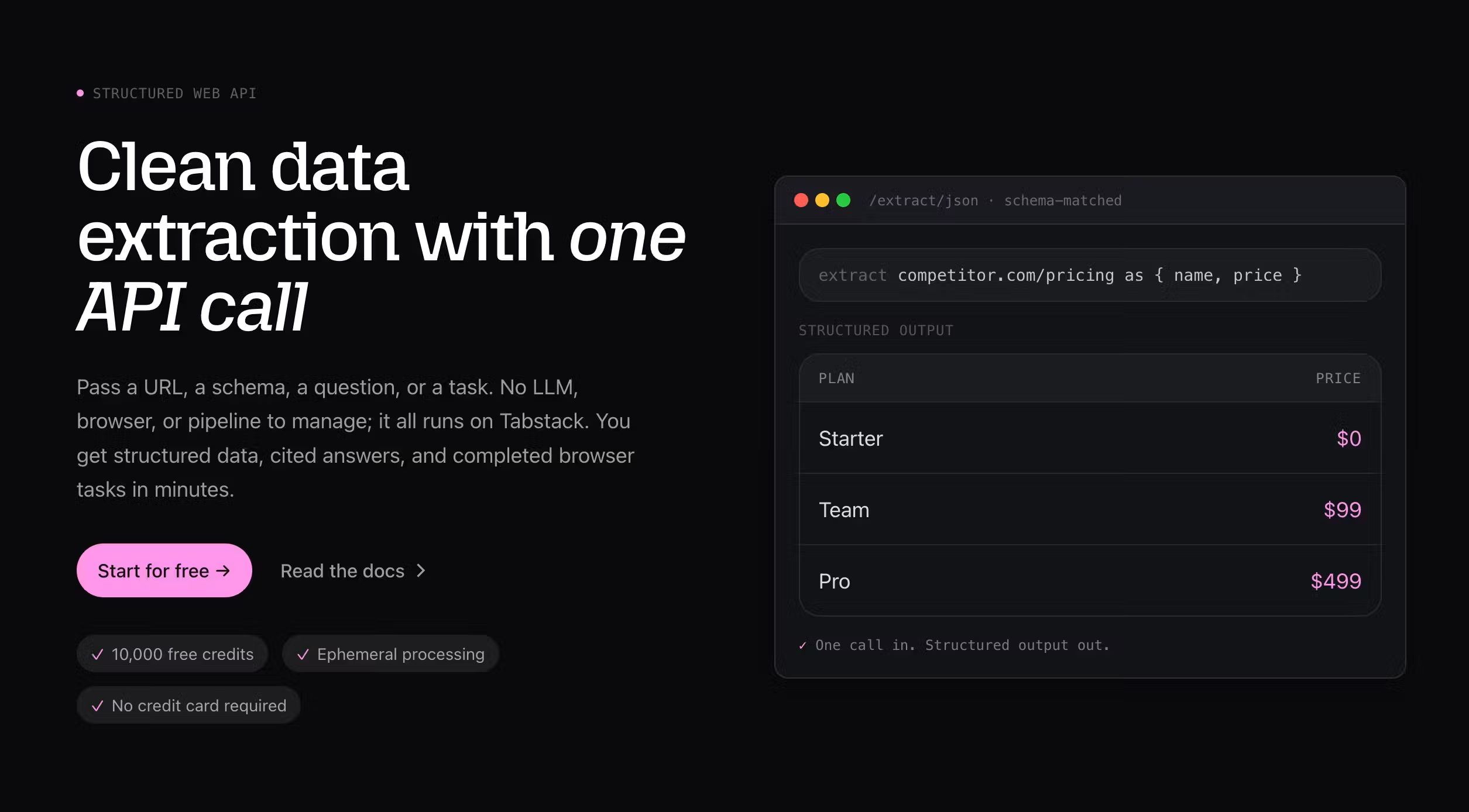
Define exactly the JSON structure you need. Pass any URL plus a schema (JSON Schema, Zod, or Pydantic) and Tabstack extracts the data, enforces the structure, and returns clean JSON — even when the page structure changes. Schema Source generates a ready-to-use schema from any URL automatically.
Cited Multi-Source Web Research
Pass a question, get back a synthesized answer with every claim cited to its source. Source selection, reading across multiple pages, synthesis, and citation all run inside the API call. No retrieval pipeline to build, no citation logic to maintain — ship a research feature users can trust in one call.
Full Browser Automation (/automate)
Describe a task in plain language, pass a URL. Tabstack navigates, clicks, fills forms, handles multi-step flows, and streams results back. Guardrails scope what the agent may do. Interactive mode pauses for human input when a step needs judgment (logins, confirmations). No browser to host, no concurrency ceiling.
Mozilla Privacy Architecture
Ephemeral processing (requests and page data purged after task completion), no model training on customer data, robots.txt compliance by default, and Mozilla-documented data practices — the kind of privacy posture that makes Tabstack viable for sensitive enterprise automation where other tools are not.
Pricing Plans
| Plan | Price | What's Included |
|---|---|---|
| Free | 10,000 credits — no credit card required | Full platform access: extract, generate, research, automate — all four endpoints available on free tier |
| Paid Credits | Credit-based, pay-as-you-go | Markdown extract: 10 credits/call · JSON extract: 50 credits/call · Generate: 100 credits/call · Automate: 100 credits/action · Fast research: 250 credits/call · Balanced research: 350 credits/call |
| Enterprise | Custom pricing | High-volume automation, priority support, compliance controls, dedicated infrastructure |
Extract and generate are fixed-cost per call — one action, one price. Automate and research are variable — they chain as many actions as the task needs and bill per action. A research call that reads more sources costs more. Use guardrails and max-iteration caps on automate calls to control variable costs while learning your workload patterns.
Start Building With Tabstack — 10,000 Free Credits →Pros & Cons
✓ What Works
- ✅ Accessibility-tree architecture — 60–80% fewer tokens than screenshot-based agents, making high-volume browser automation economically viable
- ✅ Unified credit system across all four endpoints — one currency, no separate billing lines for extraction vs. research vs. automation
- ✅ Mozilla-backed privacy — ephemeral processing, no model training, robots.txt compliance, documented data practices
- ✅ 10,000 free credits with no credit card — generous enough to fully evaluate all four endpoints in real workloads before committing
✗ What Needs Work
- ❌ Automate and research have variable costs — per-action billing means complex tasks can consume credits unpredictably; requires guardrails and iteration caps in production
- ❌ Not an anti-detect browser — Tabstack is not designed for bypassing bot detection or scraping sites that actively block automation; Camoufox or similar tools serve that use case
- ❌ robots.txt compliance by default — honorable but means some data sources Tabstack won't touch that raw scrapers will
- ❌ Early access stage — some enterprise features and documentation depth still maturing; complex integration use cases require direct team engagement
💡 Community Feedback: What Developers Say
How It Compares to Alternatives
| Capability | Tabstack | Firecrawl | Browserbase | Self-Hosted Playwright |
|---|---|---|---|---|
| Token Architecture | Accessibility tree (60–80% fewer) | Screenshot-based | Screenshot-based | Screenshot-based |
| Managed Infrastructure | YES — browser + LLM included | YES — browser only | YES — browser only | NO — self-manage |
| Cited Research Endpoint | YES — built-in | NO | NO | NO |
| Privacy | Mozilla-backed, ephemeral | Standard | Standard | Self-controlled |
| Free Tier | YES — 10K credits | YES — limited | YES — limited | Always free |
The comparison table reveals a clear hierarchy in the browser automation API landscape. Tabstack is the only platform that combines accessibility-tree token efficiency, managed browser and LLM infrastructure, a built-in cited research endpoint, and Mozilla-grade privacy — all behind a single credit system. Firecrawl and Browserbase are competent browser infrastructure tools, but they require you to bring your own LLM and do not offer the cited research or Markdown generation endpoints natively. Self-hosted Playwright gives you full control but at the cost of owning every layer of the stack — browsers, proxies, LLM integration, and maintenance. For teams who want to ship web-data features rather than maintain infrastructure, Tabstack is the most complete option.
Who Should Use Tabstack?
Best For: Developers and AI teams building agents or features that need live web data — structured extraction for data pipelines, cited research for in-product AI features, and browser automation for multi-step workflows on third-party sites. SaaS teams adding booking, scheduling, data extraction, or form-filling features that must work on JavaScript-heavy pages you do not control. Operations teams replacing brittle RPA scripts that break on every site update. Teams who have hit the token cost ceiling of screenshot-based browser agents and need a more efficient architecture at scale.
Consider Alternatives If: You need anti-detect browser capabilities to bypass bot protection on sites that block automation — Camoufox, Browserbase with stealth, or similar tools serve that use case. You need a full browser agent framework with custom LLM control and step-level debugging — Daily Bots/Pipecat or a custom Playwright stack give you more granular control. You are building simple scraping of static HTML pages without JavaScript rendering — basic HTTP clients with BeautifulSoup are cheaper and faster. You need guaranteed fixed costs per task — Tabstack's variable automate/research billing requires upfront workload modeling.
Expert Editorial Opinion
Tabstack's architectural choice to use the accessibility tree instead of screenshots is the most significant technical decision in the browser automation API category in 2026 — and it is the correct one. The vision-token problem is real and growing: screenshot-based browser agents send a full-page image on every action, consuming thousands of tokens per step. For simple tasks this is manageable. For production-scale automation — hundreds of tasks per hour, multi-step flows on complex pages — the economics become prohibitive. Tabstack's accessibility-tree approach cuts that cost 60–80% per action. That is not an optimization. At scale, it is the difference between a feature that ships and one that does not.
The Mozilla backing is doing real work in this product — not just as a marketing signal, but as an architectural constraint. The ephemeral processing model (data purged after task completion), documented data practices, robots.txt compliance by default, and explicit no-training-on-customer-data commitment reflect the institutional values of an organization that has spent twenty years building internet infrastructure around privacy as a principle rather than a feature. For enterprise teams evaluating browser automation platforms, the Mozilla provenance simplifies procurement conversations that are otherwise lengthy. The JustSteveKing review is correct: this kind of privacy posture should be table stakes and somehow rarely is.
The four-endpoint unified platform is the right scope. Extraction, Markdown generation, cited research, and browser automation cover the complete surface area of what agents and AI features need from the live web — and putting them behind a single credit system rather than separate billing lines eliminates the overhead of managing multiple web data vendors. The Schema Source tool (generates a ready-to-use JSON schema from any URL automatically) is the kind of thoughtful developer ergonomic that reduces time-to-first-call from hours to minutes. For teams who want to stop owning a scraping stack and start shipping the AI feature that requires live web data, Tabstack is the most complete and most trustworthy option available in mid-2026.
The pricing gap is worth examining closely. The 10,000 free credits are genuinely generous — enough to evaluate all four endpoints in real workloads before committing. But the variable cost structure on /automate and /research means production budgeting requires upfront modeling. A research call that reads ten sources costs significantly more than one that reads two. An automation task that navigates five pages costs more than one that navigates one. This is the correct tradeoff for infrastructure that bills for actual work done, but it means teams need guardrails, max-iteration caps, and monitoring before scaling. The fixed-cost endpoints (/extract at 10–50 credits, /generate at 100 credits) are safe and predictable. The variable ones require discipline.
Does Tabstack justify its existence without a free tier? The free tier exists and is excellent, so the question is moot for evaluation. But the deeper question is whether a developer would pay for this once the 10,000 credits are exhausted. For teams running production browser automation at scale, the answer is unambiguously yes — the token savings alone repay the cost. For teams doing occasional extraction or research, the pay-as-you-go model means you only pay for what you use. The absence of a subscription requirement (pure credit-based) is the right pricing model for infrastructure that serves workloads of wildly different shapes and sizes.
Final Verdict
Tabstack by Mozilla is the best managed browser automation and web data API available for developers building AI agents in 2026. The accessibility-tree architecture delivers 60–80% token savings over every screenshot-based competitor. The four-endpoint unified platform — extract, generate, research, automate — covers the complete live-web surface area agents need. The Mozilla privacy architecture is the most credible data-handling posture in the category. The 10,000 free credits with no credit card provide genuine evaluation depth. Variable costs on automate and research require workload modeling and guardrails before production deployment — but that is the correct tradeoff for an infrastructure tool that bills for actual work done. For any developer team who has been maintaining a scraping stack, this is a 9.3 out of 10 and the first API worth replacing it with.
🔗 Related ToolRadar Reviews
More tools from AI Developer Tools
- The Voice Agent Platform That Solved Real-Time Conversational AI
- I Built an AI Agent Army Without Writing a Single Line of Code
- Your AI Agents Have Security Holes — This Tool Fixes Them
- Beyond the Hype: Google ADK 2026 AI Agent Framework Review
- This AI Agent Replaced My Entire Team's Workflow
- The Search Engine Built for AI Agents
- I Gave an AI Agent Full Control of My Workflow
- The Hidden Cost Trap Behind $0.05 Voice Agent Pricing
❓ Frequently Asked Questions
How long will you keep maintaining a browser farm before you admit the scraping stack was never supposed to be your product?
Tabstack is the first API that makes that admission for you — and gives you the infrastructure to ship what you actually set out to build.
Comments
Post a Comment