


DepthData Review 2026: An Unusually Honest Pitch for AI Spend Tracking, Still Pre-Launch
DepthData scores 6.0/10 in ToolRadar's independent review — a solo-built, pre-launch tool for tracking AI spend and adoption across every vendor a company uses, tested against its own site, its Product Hunt launch thread, and an honest look at what ‘no customers yet’ means here.
Reviewed by the ToolRadar editorial team, based on the company's official site and its Product Hunt launch thread.
DepthData wants to answer a question a lot of finance teams are quietly struggling with right now: a company pays for ChatGPT, Claude, Copilot, and Gemini, and nobody can say with a straight face what any of it is actually returning. After reading through the product's own site, its Product Hunt launch page, and the questions real commenters raised on day one, ToolRadar found an unusually honest pitch for a product that, by its own admission, doesn't have a single customer yet.
The idea is a read-only layer that connects to the admin consoles of ChatGPT Enterprise, Claude, Copilot, Gemini, Cursor, and a dozen other AI tools, and normalizes their wildly different definitions of 'active user' into one schema a CFO can actually sign off on. Every number on the dashboard is tagged as measured, derived, or modelled, so nobody mistakes an estimate for a fact. It's built solo by product designer Ali Berk Uyanik, and it launched on Product Hunt this week to a small but sharp set of first-day questions that haven't all been answered yet. This review covers what the product actually promises, an oddity worth knowing about on its own live marketing site, and why 'no customers yet' matters more here than it usually would.
What Is DepthData?
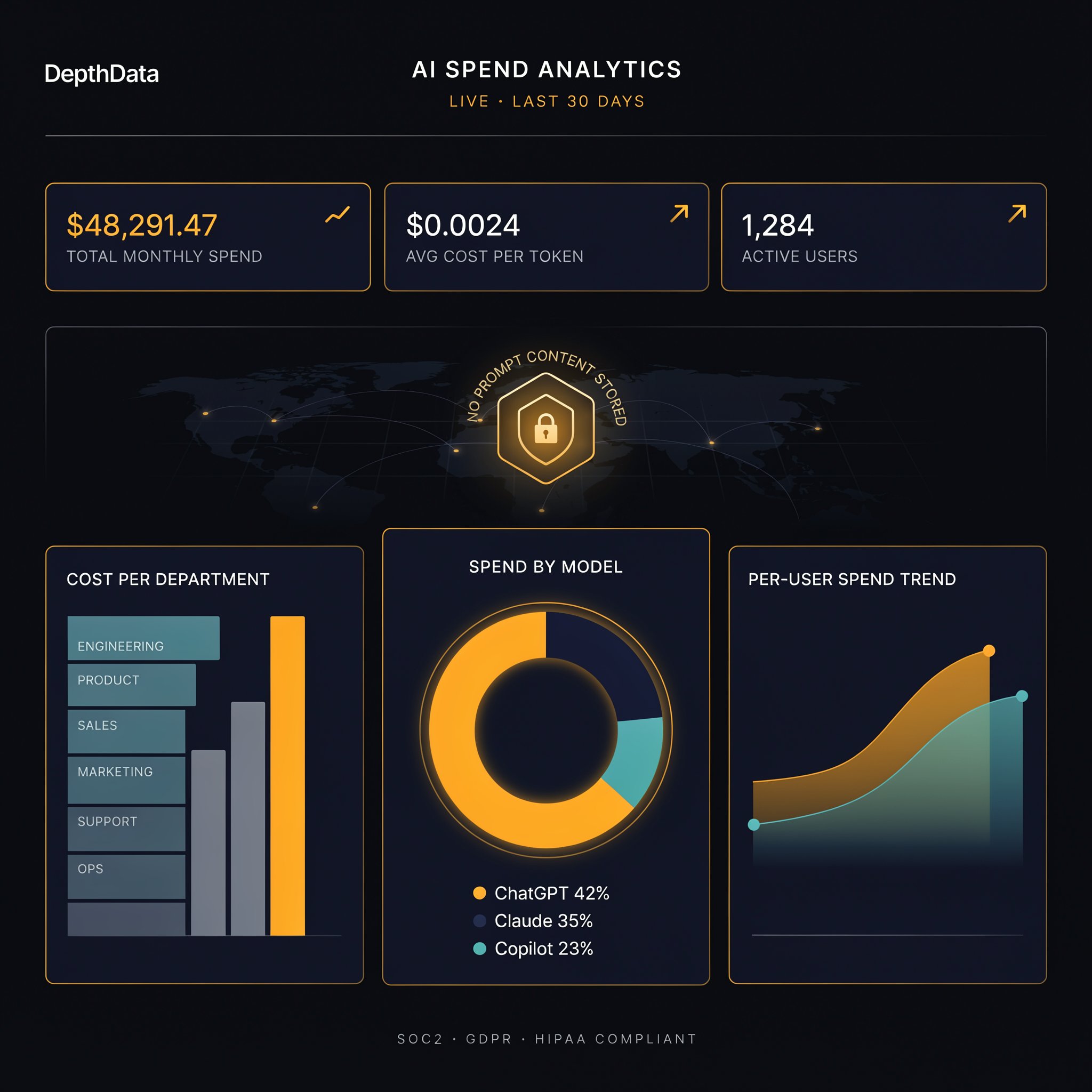
DepthData is a spend-and-adoption intelligence layer for company-wide AI tool usage. It connects, read-only, to the admin APIs of tools like ChatGPT Enterprise, Claude, Microsoft Copilot, Gemini, Cursor, Perplexity, Notion AI, and several model providers, and folds seats, sessions, usage, and spend into one normalized schema — so 'active user' finally means the same thing whether it's coming from OpenAI's console or Anthropic's. The product publishes a connector matrix showing exactly what each vendor's API does and doesn't expose today, and explicitly states it never ingests prompt content, even when a vendor's own feed technically includes it. As of this review, the company states plainly on its own site that it has no customers yet — every number shown in the product demo comes from a modelled workspace, not a real deployment.
💡 Sharp Questions From Launch Day, Still Open
Key Features
Confidence-Labeled Numbers (Measured, Derived, Modelled)
Every figure DepthData shows carries one of three labels: measured (pulled directly from a vendor's own API — seat counts, timestamps, invoices), derived (arithmetic performed on measured numbers, with the formula published), or modelled (an estimate, which always ships with a confidence range rather than a single misleadingly precise number). The company frames this explicitly as a tradeoff — their headline numbers look smaller and less impressive than a dashboard that doesn't separate counted figures from estimated ones, and they say that's the point: a number a finance team can actually audit is worth more than one that just looks confident. It's a genuinely uncommon level of self-imposed discipline for an analytics product, though it's worth remembering this is a design promise from a pre-launch product, not yet a pattern verified across real customer deployments.
Read-Only Connectors With a Published Coverage Matrix
DepthData publishes a connector matrix showing exactly what each vendor's admin API can expose — seats and roles, usage and adoption, spend, and audit events — and marks the gaps openly rather than papering over them. As of this review, six of eight tracked vendors expose seats, usage, and spend through an official API, while two expose seats only, with no usage or spend endpoint at all; the site names Lovable specifically as a vendor that currently exposes nothing beyond seat counts through SCIM. Every connection is read-only OAuth into the vendor's own console, with no agent installed on any employee's laptop and no browser extension. Two real commenters pushed on this during the Product Hunt launch — one asking whether spend is pulled from provider billing or usage logs and whether it can be attributed to a specific team or project, and another pointing out that a seat-level view treats a light user and a power user as identical on usage-priced tools, which is exactly where the real waste tends to hide. Neither question had a public answer as of this review.
Waste Ledger: Named Seats, Not Guessed Percentages
Rather than reporting a single scary percentage of 'wasted' spend, DepthData's waste ledger ranks specific, named opportunities — 64 seats paying for an enterprise tier at free-tier usage intensity, 13 dormant ChatGPT seats with no prompts in 30 days, 18 idle Copilot licenses, 9 people with duplicate coverage across two tools — each traceable back to actual seats rather than an assumed percentage. The demo workspace notably declines to recommend the biggest possible savings figure: a full downgrade would save roughly four times what the ledger actually recommends, but the product explicitly argues against it because it would also break more than a hundred power seats whose heavier usage is justified by their workload. That's a deliberately smaller, more defensible number over a flashier one, which fits the product's stated philosophy — though again, this is demonstrated on a modelled workspace, not a live customer account yet.
Baseline Against Your Own Workspace, Not an Industry Benchmark
Instead of comparing your company's AI adoption to an industry benchmark nobody can verify, DepthData grades progress against what your own workspace was doing in its first four weeks, team by team. The stated reasoning is that an industry average can always be dismissed as not applicable to your company, while a comparison against your own history can't be argued away the same way. This also means there's currently no external benchmarking feature at all — the site lists cross-company benchmarking explicitly as a future direction, dependent on enough workspaces existing for the comparison to be meaningful, which by the company's own account, isn't the case yet.
Who Should Use DepthData?
Best For: Finance and IT leaders at companies already juggling four or more separate AI tool subscriptions, who are comfortable being an early, hands-on partner for a solo-built, pre-revenue product in exchange for input into its direction.
Consider an Alternative If: You need something live today rather than an early demo, you'd rather lean on each vendor's own increasingly capable native analytics (OpenAI, Anthropic, and Microsoft have all shipped their own usage and spend dashboards this year), or you want a vendor with an existing customer base like Worklytics to point to.
Setup and Learning Curve
There's no live product to test yet beyond the demo request — the entire user experience described on the site (connect via read-only OAuth, roughly an hour of admin setup per vendor console) is aspirational until a real workspace goes through it. The most concrete promise is that setup requires zero installs on any employee's device, which if it holds up in practice would make this meaningfully lower-friction than an agent-based monitoring tool. Until a real deployment is documented, this section is a description of the plan, not a tested account of the process.
DepthData vs. Competitors
| Tool | Best For | Pricing | Maturity |
|---|---|---|---|
| DepthData | Cross-vendor normalized adoption + spend, confidence-labeled | Not yet published, demo only | Pre-launch, zero customers |
| Worklytics | AI adoption analytics correlated with productivity data | Custom / enterprise pricing | Established, existing customer base |
| Native Vendor Dashboards | Single-vendor usage & spend (ChatGPT, Claude, Copilot) | Included with Enterprise/Team plans | Free, but siloed per vendor |
DepthData Pricing
| Stage | What's Available | Cost |
|---|---|---|
| Right Now | Early demo request via waitlist form | Not yet published |
| What You See | A modelled demo workspace, not live customer data | N/A |
| Setup (Per Site) | Read-only OAuth per vendor console, ~1 hour | N/A |
ToolRadar has no affiliate relationship with DepthData — the link above goes directly to the official site.
Pros and Cons
✓ What Works
- ✅ Unusually honest design philosophy: every number is labeled by how confident the company actually is in it, including admitting where it's just an estimate
- ✅ A published connector matrix names exactly which vendors expose what, instead of vaguely promising universal coverage
- ✅ Read-only by design — no agents on employee laptops, and prompt content is explicitly never ingested
- ✅ The waste-ledger approach recommends specific named seats to cut, and explicitly argues against a bigger but riskier number
✗ What to Watch For
- ❌ The company states directly on its own site that it has no customers yet — every dashboard figure shown is from a modelled demo workspace, not a real deployment
- ❌ The live marketing site currently contains unfilled placeholder text (bracketed notes reading things like 'STAT NEEDED') in its problem-statement section, a sign of how early this launch is
- ❌ The site displays SOC 2 Type II and GDPR badges despite explicitly having no customers yet — worth confirming directly with the company what stage those certifications are actually at
Expert Editorial Opinion
The most impressive thing about DepthData isn't a feature — it's the writing. A pre-launch product that voluntarily documents which features it chose not to build, and why, is rare, and the stated logic (label every number's confidence, recommend the smaller defensible saving over the bigger risky one, grade against your own baseline instead of an industry benchmark nobody can verify) is the kind of discipline most analytics vendors only claim after a security review forces them to.
The honesty cuts both ways, though, and it's worth taking at face value: this is, by the company's own explicit statement, a product with no customers yet. Every dashboard screenshot, every named seat in the waste ledger, every dollar figure on the site comes from a modelled demo workspace, not a real deployment. That's not a criticism of the idea — it's just the correct frame for evaluating it: this is a pitch, not yet a track record.
The competitive picture has also shifted underneath this product faster than most pre-launch startups have to deal with. OpenAI shipped consolidated usage analytics and spend controls for ChatGPT Enterprise in June 2026; Anthropic gave Claude Enterprise admins usage and cost by group and by user in July; Microsoft's Copilot Dashboard and Google's Gemini admin reports already exist too. Every one of those is free with the enterprise contract a company already has. DepthData's actual pitch has to be the cross-vendor normalization — one definition of 'active' across all of them — rather than any single vendor's dashboard, because the single-vendor version of this problem is being solved by the vendors themselves in real time.
There's no pricing to evaluate yet, which is honestly consistent with everything else here — a company this transparent about not having customers isn't going to publish a price list it can't yet defend either. The oddity worth flagging is smaller but real: the public site currently displays unfilled placeholder text in its own problem-statement section, and shows SOC 2 Type II and GDPR badges on a product that says outright it has no customers. Neither is necessarily dishonest — the certifications may genuinely be in progress — but both are worth a direct question to the company before you take them at face value.
For a finance or IT leader who's already living the four-different-admin-console problem this product describes, requesting the early demo costs nothing and the underlying idea is a genuinely good one. Just go in knowing you'd be an early design partner for a solo-built, pre-revenue tool, not a customer of a proven system — and treat the certification badges as a question to ask directly, not a box already checked.
Final Verdict
DepthData's idea — one normalized, confidence-labeled view of AI spend and adoption across every vendor a company uses — is a genuinely good answer to a real and growing problem, and the product's own writing about its tradeoffs is more honest than most funded competitors bother to be. But it launched this week as a solo project with zero customers, no published pricing, a couple of sharp unanswered questions from its own launch thread, and a security-badge claim that sits oddly next to its own admission of having no customers yet. Worth requesting the early demo if the four-admin-console problem is real for your team; treat everything else as a pitch to verify, not a track record to trust.
Concept & Transparency: 8.8/10 · Market Timing: 6.0/10 · Proven Track Record: 2.0/10
🔗 Related ToolRadar Reviews
More tools from AI Analytics
- The $51M Enterprise AI Workspace
- I Cut My AI Inference Costs by 50%
- Arize AI Review 2026: Enterprise AI Observability
- The Hidden Cost Trap Behind $0.05 Voice Agents
- Devin Costs Hundreds, OpenHands Costs Less
- The App That Turned My $0 Budget Into a Real Product
- I Gave an AI Agent Full Control of My Inbox
- I Built a Production AI Agent in 10 Minutes
❓ Frequently Asked Questions
Juggling four or more AI tool subscriptions with no single view of what they cost?
Requesting DepthData's early demo costs nothing, but go in treating it as a pitch from a pre-revenue solo project, not a finished product with a track record.

Comments
Post a Comment