


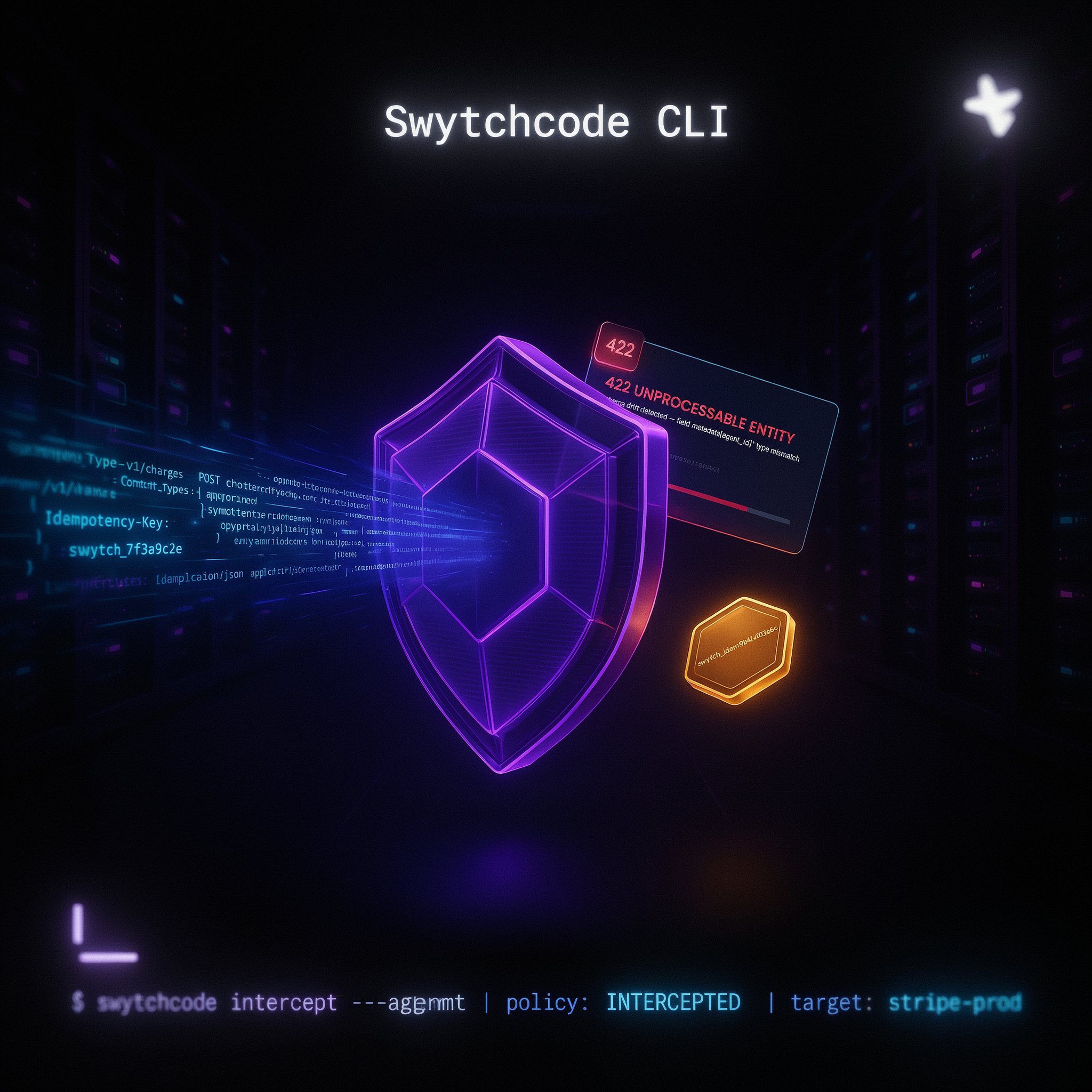
How Swytchcode CLI Gives AI Agents Reliable Access to 2,000+ Production APIs
Swytchcode CLI scores 7.5/10 in ToolRadar's independent review — a command-line execution layer that sits between AI agents and more than 2,000 production APIs, tested against its documentation, Product Hunt track record, and published pricing.
Comprehensive review based on official company documentation and verified user reviews.
AI agents are good at deciding what to do. They're much less reliable at actually doing it against a real production API. A payment call times out after the charge already went through. A CRM update retries and quietly duplicates a record. A model invents an endpoint that never existed, or skips a required field and gets back a 200 that isn't really a success.
Swytchcode CLI is built to sit in that gap. It's a command-line execution layer that routes agent tool calls through authentication, retries, idempotency, and policy enforcement before they touch a real API — across a claimed library of more than 2,000 integrations including Stripe, GitHub, Slack, Notion, HubSpot, Salesforce, Jira, and Twilio. The company describes its own homepage failure examples bluntly: Stripe silently renaming a field and returning a 400 with no trace of what changed, or Resend returning a 200 with a 422 buried in the body while the agent logs success and no email ever sends. Those are the exact failure modes Swytchcode is built to catch before they reach a user. This review covers what that actually looks like in practice, what real reviewers and independent write-ups have said, and where the pricing gets tight once you're past the free tier.
What Is Swytchcode CLI?
Swytchcode CLI is a developer tool that gives AI agents a controlled execution layer for production APIs, sitting between an agent and the real systems it needs to touch. Install the CLI, pull an integration manifest for the API you need, and route calls through it with a single command — swytchcode exec — that validates the request against a policy manifest before it ever executes. It's built to work alongside Cursor, Claude, Copilot, LangChain, CrewAI, or custom agent code, and the company's stated goal is narrow and specific: agents should focus on workflow logic, while a deterministic layer underneath handles the fragile, easy-to-get-wrong parts of talking to a real API.
Key Features
Policy-Controlled Execution, Not Raw API Calls
Every call routed through swytchcode exec is validated against a policy manifest before it executes — authentication is handled once and stored, not passed raw through agent prompts, and each request is checked against rules you set rather than trusted blindly. The company's own before-and-after example is concrete: a raw API call that fails silently because a required parameter was skipped becomes, through Swytchcode, a call that's rejected with a clear reason before it ever reaches the production endpoint. That's a meaningfully different failure mode than an agent discovering the problem only after a customer complains.
Idempotency and Durable State
Every call routed through Swytchcode is idempotency-keyed, meaning a retried request that already succeeded won't duplicate the effect — a payment charged once stays charged once, a CRM record updated once doesn't get a duplicate. State persists durably across the call, so a crash or timeout mid-request doesn't leave the system in an ambiguous state where nobody knows if the operation actually completed. This is the specific technical answer to two of the three failure examples the company itself leads with in its own marketing: a payment that times out after the charge was created, and a CRM update that retries into a duplicate record.
Schema Drift Detection
APIs change field names, deprecate parameters, and shift response shapes without much warning, and an agent calling a raw endpoint has no way to know that happened until something breaks downstream. Swytchcode validates each call's schema before execution and flags drift — a renamed field, an unexpected response shape — with a clear error rather than letting a mismatched request fail silently or, worse, appear to succeed. It's a small-sounding feature that solves a genuinely common and hard-to-debug class of problem.
Broad Integration Library
The integration hub covers more than 2,000 APIs, including well-known names like Stripe, GitHub, Slack, Notion, HubSpot, Salesforce, Jira, Linear, Twilio, Airtable, Figma, and Vercel, alongside a bring-your-own-OpenAPI-spec option for anything not already in the library. Coverage this broad matters most for teams whose agents need to touch several different services in one workflow — onboarding a customer that requires a CRM update, a Slack notification, and a billing action, for instance — without hand-writing a separate SDK integration and retry policy for each one.
Swytchcode CLI Pricing
| Plan | Price/Month | What's Included |
|---|---|---|
| Free | $0 | Up to 1,000 execution calls/month, community support |
| Pro | $29 | Up to 5,000 execution calls/month, email support |
| Immortal | $100 | Up to 500,000 execution calls/month, Slack support |
ToolRadar has no affiliate relationship with Swytchcode — the link above goes directly to the official site.
Pros and Cons
✓ What Works
- ✅ Solves a specific, well-documented class of production failure — schema drift, silent errors, timeout duplication — rather than a vague general promise
- ✅ Broad integration library (2,000+ APIs) plus a bring-your-own-spec option for anything missing
- ✅ Free tier is genuinely usable for testing (1,000 calls/month) before any payment is required
- ✅ Track record across two distinct Product Hunt launches, including a #1 Product of the Day finish, rather than a single unproven debut
✗ What to Watch For
- ❌ The jump from Pro's 5,000 calls/month at $29 to Immortal's 500,000 at $100 is a steep step with nothing in between for a team that outgrows Pro but doesn't need Immortal's full volume
- ❌ Independent review volume is still thin — 5.0/5 on Product Hunt, but from only 4 reviews, and GoodFirms lists zero submitted reviews as of this writing
- ❌ The tool adds real value for agents taking write actions against production systems; for read-only research agents or early prototypes that never touch production, it's more infrastructure than most setups currently need
💡 What Real Users Are Saying
Swytchcode CLI vs. Competitors
| Tool | Best For | Starting Price | Approach |
|---|---|---|---|
| Swytchcode CLI | Policy-controlled execution for agents taking real actions | Free, then $29/mo | Deterministic layer between agent and 2,000+ APIs |
| Zapier AI | No-code workflow automation across apps | Free tier, paid plans scale by usage | Visual workflow builder, not agent-native |
| n8n | Self-hosted, open-source workflow automation | Free self-hosted, or paid cloud tiers | Node-based automation, broader than agent tool-calling |
Setup and Learning Curve
Getting a first call working is quick: install, pull a manifest for the API you need, and run swytchcode exec with the relevant action. The company advertises validation and policy checks completing in under 50 milliseconds, so there's no noticeable slowdown even across a multi-step agent workflow. The real learning curve isn't the CLI syntax itself — it's writing sensible policy rules for each integration, which takes more up-front thought than just handing an agent a raw API key, but pays that thought back the first time a schema changes without warning.
Who Should Use Swytchcode CLI?
Best For: Teams building agents that take real, consequential actions — creating payments, updating CRM records, sending messages, provisioning accounts — where a silent failure has a real cost, and platform engineering teams that want audit trails and policy enforcement across every API their agents touch, not just the ones a developer remembered to add error handling for.
Look Elsewhere If: Your agents are read-only research tools that never write to production, you're still prototyping and haven't hit real integration failures yet, or you already have a mature internal workflow engine handling policy, retries, and idempotency — in which case Swytchcode is solving a problem you've already solved another way.
Expert Editorial Opinion
What stands out here is specificity. A lot of "AI agent infrastructure" pitches stay abstract — reliability, observability, trust — without naming an actual failure mode. Swytchcode's own homepage leads with exact scenarios: Stripe renaming a field and returning an untraceable 400, Resend returning a 200 with a 422 buried in the body. Those are real, common, and genuinely hard for a model to catch on its own, since the API is technically responding, just not with what the agent expects.
The two-launch history is worth reading as a real signal, not just a marketing timeline. Swytchcode won #1 Product of the Day in November 2025 as a web-based tool, then rebuilt around a CLI-first architecture for its June 2026 relaunch after the team said usage data pointed there. Pivoting the core product interface based on how people actually used version one, rather than defending the original bet, is the kind of decision that suggests real usage data existed to act on.
Independent validation is still thin, though, and it's fair to say so plainly. The Product Hunt rating is a genuine 5.0, but out of only 4 reviews. GoodFirms shows zero submitted reviews. The two customer testimonials on Swytchcode's own site are specific and plausible — a stated drop from three weeks to two days for partner integration, a jump from weeks to a single terminal command — but they're company-published, not independently sourced, and should be weighted accordingly.
The pricing tiers themselves are transparent, which is worth crediting: exact call limits and dollar amounts are published, not hidden behind a "contact sales" wall until Enterprise. The real gap is the jump from Pro's 5,000 calls a month at $29 to Immortal's 500,000 at $100 — a team that outgrows Pro but only needs, say, 20,000 calls a month is paying for either far more headroom than it needs or negotiating a custom Enterprise deal for a mid-size gap that arguably deserves its own tier.
Past the free 1,000 calls, is it worth $29 a month? For a team whose agents are already taking real production actions and have been burned by even one silent schema-drift failure or duplicate charge, yes — that's a low price relative to the cost of one bad incident. For a team still prototyping, the free tier is generous enough to validate the value before paying anything, which is exactly how it should be used before committing further.
Final Verdict
Swytchcode CLI solves a real, specific, well-articulated problem: AI agents are good at deciding what to do and bad at reliably executing it against production APIs that fail in quiet, easy-to-miss ways. The technical approach — policy validation, idempotency, schema drift detection, all before a call executes — directly addresses the exact failure examples the company leads with, and a two-launch track record with a genuine pivot toward what developers actually wanted is a better signal than most single-launch debuts. Independent review volume is still thin, and the pricing ladder has an awkward gap in the middle, but the core idea is sound and the free tier costs nothing to test against your own integration failures.
Technical Quality: 8.2/10 · Price-to-Value: 7.6/10 · Maturity & Documentation: 6.8/10
🔗 Related ToolRadar Reviews
More tools from AI Agent Infrastructure
- Zapier Had a Good Run, n8n Just Made It Complicated
- Zapier AI Review 2026: Automation Tool
- The Browser Automation API That Reads the Page for You
- I Built a Production AI Agent in 10 Minutes
- I Gave an AI Agent Full Control of My Inbox
- This AI Agent Replaced My Entire Team's Workflow
- Beyond the Hype: Google ADK 2026 AI Agent Framework
- Can an AI Agent Really Replace Your Job?
❓ Frequently Asked Questions
Had an agent silently fail against a production API and not find out until a customer complained?
The free tier covers 1,000 execution calls a month — enough to route your riskiest integration through it and see whether the failures actually get caught before they matter.

Comments
Post a Comment