


LangChain Review 2026: LangGraph, Deep Agents and What You Actually Pay For
LangChain is free, LangGraph is free, and the company still sells a platform around them. Here is how the layers fit together, what the 1.0 reset changed, what LangSmith really costs, and which popular alternative no longer exists.
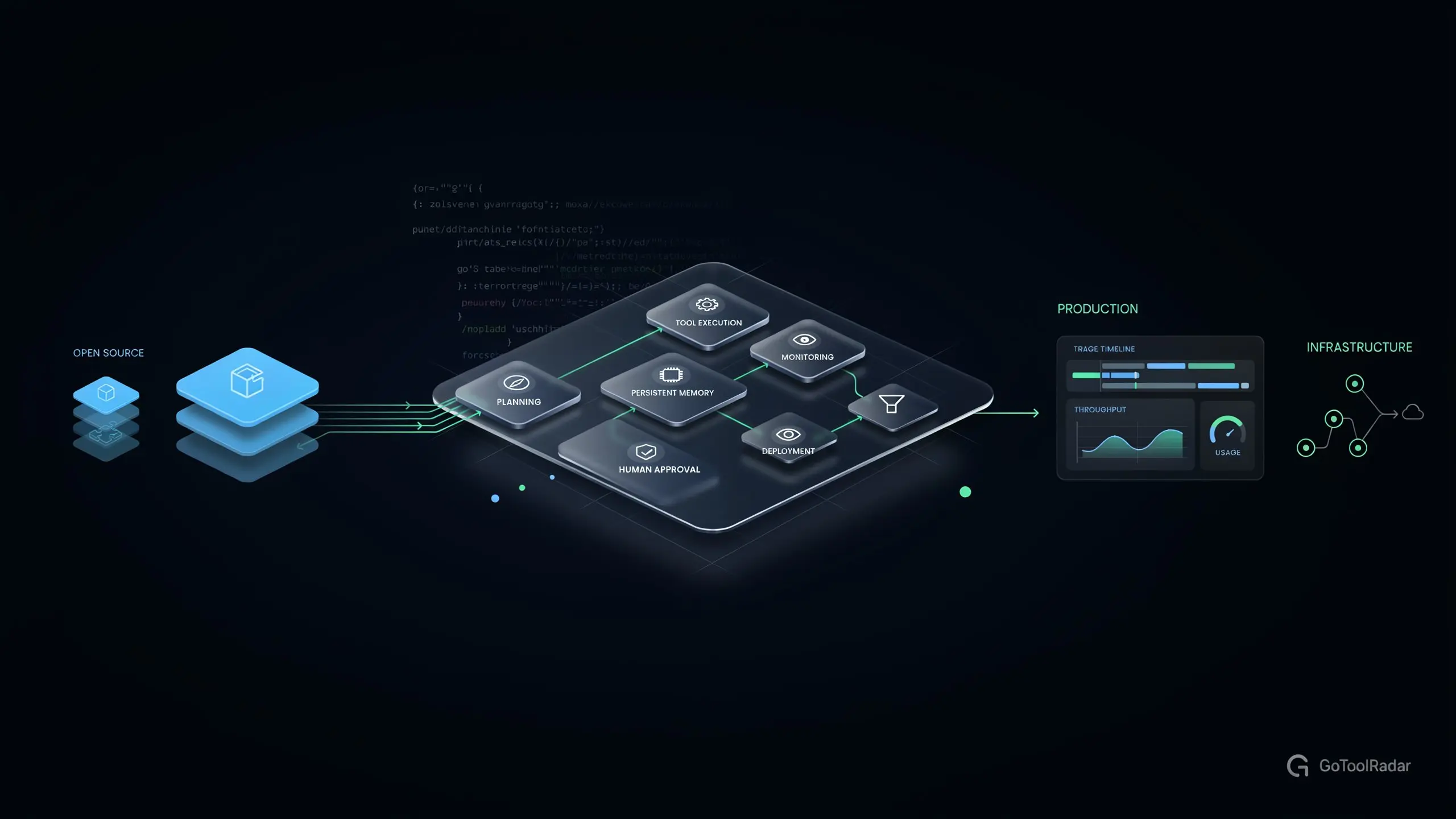
This LangChain review 2026 has to start by untangling names, because most confusion about the project comes from treating four different products as one. LangChain is the framework, LangGraph is the runtime underneath it, Deep Agents is a ready-made harness on top, and LangSmith is the paid platform for tracing, evaluation and deployment.
That split matters for cost, for risk and for how you decide whether to use any of it. The libraries are open source and free. The money is in the platform, and the platform's pricing changed shape this year. We checked LangChain's official pricing page, its release notes and its funding announcements, and we also checked whether the alternatives suggested to us still exist. One of them doesn't.

Four Names, Three Layers
LangChain's own description is that you build agents with its open-source frameworks, and that the rest of the stack supports them. The practical question is which layer your project needs.
The quick-start framework: provider-agnostic models, tools, retrieval and an agent factory called create_agent. Since the 1.0 rewrite it is opinionated, focused, and runs on LangGraph's runtime.
The orchestration layer for custom agents: durable execution for long-running tasks, memory, and human-in-the-loop approvals. You can use it without LangChain, and LangChain's agents already run on it.
An open-source harness, first published in July 2025, for long-running agents. In August 2026 LangChain shipped Deep Agents v0.7 and put a managed version and an LLM gateway into public beta.
The boundary is intentionally blurry. Because LangChain's agents are built on LangGraph, a simple agent never shows you a graph, and you move down a layer only when you need finer control over steps, state or approvals. A question-answering bot with one model and a search tool probably needs only LangChain. An agent that plans, runs many steps, saves progress and pauses for a human sign-off before a sensitive action is where LangGraph earns its place.
A caveat on all of this: LangGraph gives you structure for controlling execution, not correct decisions. Whether the model chooses the right tool, or the tool does what you intended, still needs your own tests.
The v1 Reset and the Churn Tax
The project's reputation for breaking changes is older than its current state. In October 2025 LangChain and LangGraph both reached 1.0, with LangChain rewritten to be smaller and more opinionated, and with a promise of no breaking changes until 2.0. Legacy chains and the old AgentExecutor moved to a separate langchain-classic package, which is why tutorials from 2023 and 2024 so often fail on a fresh install.
Stability has been real since then, but the pace hasn't slowed. Releasebot's tracker shows LangGraph 1.2.14 on October 6, 2026, langchain 1.4.3 on September 28, and a steady stream of langchain-core and provider-package releases in between, while Deep Agents has reached the 0.7 line. None of that is a defect, but it does mean your dependency pins and your team's habits need to keep up.
That is the real cost of the ecosystem's breadth. Integrations and abstractions speed up the first week, and can make the system harder to reason about in month six if you don't understand the model calls, tool loops and state underneath. If your use case is a thin wrapper around one provider's API and a queue, a framework may add more surface than it removes.
What's Free, What's Metered
The open-source libraries cost nothing, and LangSmith is a separate, optional product. LangChain's pricing page lists three plans, plus usage on top.
| Plan | Price | What it includes |
|---|---|---|
| Open-source libraries | $0 | LangChain, LangGraph and Deep Agents under open-source licenses; model API calls are billed by your provider |
| LangSmith Developer | $0 per seat | One seat, up to 5k base traces a month, then pay as you go, community support; Fleet pauses when its monthly allowance of 7 units is used |
| LangSmith Plus | $39 per seat per month | Unlimited seats, 10k base traces a month, one free small serverless deployment, access to Deployment, Engine and Fleet (37 units included) |
| LangSmith Enterprise | Custom | Cloud, hybrid or self-hosted, custom SSO, support SLA |
| Metered usage | $1.00 per LSU | LangChain Standard Units cover Fleet, Engine, Sandboxes, deployment compute, tuned evaluators and more, billed on top of seats |
The shape of the bill has changed. The pricing page now describes five metered services (observability and evaluation, deployment, Fleet, Engine and sandboxes) measured in LSUs at $1 each, with published rates per vCPU-hour and GiB-hour for deployments and sandboxes. Base traces keep 14 days of retention and extended traces 180 days, and you can pay to upgrade a base trace to extended. LangChain also states that LangSmith does not use your data to train models.
Per-trace overage prices are less clear than they should be. Several third-party guides quote $2.50 per thousand base traces, one quotes $5 for extended, and one tracker says per-run deployment pricing was replaced by LSU metering in July, while the pricing page itself shows no per-trace figure in the text we could read. A guide that models 100,000 traces on Plus arrives at about $489 a month against a $39 headline, which shows how quickly usage dominates seats. Estimate with LangChain's own calculator, and compare against alternatives such as LangWatch, TruLens, Arize and Promptfoo before you commit.
Alternatives, and One That Vanished
The research brief we received for this article listed four options beside LangChain: Haystack, Google's Agent Development Kit, Flowise and the LangChain/LangGraph split itself. Three still make sense. Haystack is a retrieval-focused framework built around composable pipelines, and Google's ADK is a code-first, multi-agent toolkit optimized for Gemini and Google Cloud but designed to work with other models too. We haven't re-verified either's current licensing or pricing, so check their pages. Our coverage of Haystack 3.0 and Google ADK goes deeper on each.
The fourth, Flowise, is a different story. The brief described it as a live visual builder with Starter and Pro cloud plans at $35 and $65 a month. That is no longer the situation. Flowise's own announcement, The Future of Flowise, set a code freeze for July 29, 2026, and its GitHub repository shows it was archived on August 13, with the core team's presence ending on August 31. The Apache-2.0 code stays on GitHub and the team encourages forks, but an October 2026 security write-up says 3.1.4 was the last release and that no official fixes are coming.
Whether Flowise Cloud itself has a shutdown date is disputed: one review claims November 30, while another notes that Flowise hasn't published one. Treat any date as unconfirmed unless you got a notice from the company. Anyone choosing a visual builder should look at actively maintained options, and a recent comparison lists Langflow, Dify and n8n as still shipping; our Activepieces vs n8n vs Zapier comparison covers the automation side. Our earlier Flowise and Workday article predates the shutdown and needs updating.
Pros and Cons
✓ What Works
- ✅ Free, MIT-licensed core libraries with a stability promise: no breaking changes until 2.0.
- ✅ A clean path from
create_agentto LangGraph, with durable execution, memory and human-in-the-loop controls. - ✅ Works with many model providers, so you aren't tied to one vendor.
- ✅ A transparent pricing page with a calculator and published unit rates.
- ✅ A clear statement that LangSmith doesn't train on your data.
✗ What Holds It Back
- ❌ Fast release cadence and a legacy split into langchain-classic that confuses older tutorials.
- ❌ The bill moves from seats to usage: seats, LSUs, traces and retention all stack.
- ❌ Per-trace overage prices are hard to confirm from the official page alone.
- ❌ Abstractions can hide what is happening when something goes wrong.
- ❌ It doesn't guarantee reliable or safe agent behavior; you still need tests, permissions and review.
Who Should Use It
Best for: developers and teams building agents or retrieval apps who want one ecosystem that goes from a quick prototype to durable, stateful production agents, and who can budget for tracing, evaluation and deployment as separate line items.
Look elsewhere if: you only need a thin wrapper around one provider's API, you want a visual builder that is actively maintained, or you can't tolerate dependency churn. Teams doing retrieval-heavy work may prefer Haystack, and those on Google Cloud may prefer ADK. For related reading, see our OpenCode review.
Expert Editorial Opinion
The research we started from rated LangChain a 9.2 and treated its alternatives as a lineup of live options. Checking them showed that the lineup had lost a member, and that the pricing story we'd have repeated, tiers of seats and trace allowances, no longer describes how LangSmith charges. Neither correction hurts LangChain. Both show how quickly this part of the market moves.
Our read is simple: LangChain is a good default, and LangSmith is a business decision.
The framework earns its default status. Since the 1.0 reset, LangChain is a smaller, more focused layer over LangGraph's runtime, and LangGraph is a credible answer to the problem most agent projects eventually hit: state that must survive failures, steps that must pause for a person, and workflows that run for hours. Those are the same properties that Flowise's visual canvas, and the thin wrappers beneath many demos, were never built for. Flowise's shutdown notice, and its own explanation that developers now lean on coding agents, shows how fast that gap opens.
The pricing gap is where we'd slow down. The libraries have no free tier because they don't need one; the question is whether LangSmith is worth paying for without free tracing. For prototypes, probably not, since Developer's 5,000 base traces are enough. For production, the value is real but unbounded, because traces, retention, deployment compute and Fleet all draw down the same $1 LSU meter. Decide your trace volume and retention policy before you pick a plan, not after.
A confidence note: this is a desk review. We didn't build an agent on LangChain for this piece. Version numbers come from a release tracker and a third-party guide, the Series C valuation is unconfirmed, and per-trace overage rates are quoted by third parties, not by LangChain's own page.
Final Verdict
Strong, recommended with named caveats: LangChain and LangGraph are the most complete open-source route to production agents, and the 1.0 reset made them more stable. The caveats are a fast release pace, a metered platform whose total cost depends on usage, and per-trace pricing that third parties quote differently. Use the open-source layers freely, add LangSmith when you can describe your trace volume, and don't assume the framework makes an agent reliable.
| Dimension | Weight | Score /10 | Why |
|---|---|---|---|
| Technical quality | 30% | 8.5 | Durable execution, memory, human-in-the-loop and a clean create_agent path; evidence is documentation, not our testing |
| Price-to-value | 25% | 7.5 | Free libraries and a free Developer tier, but seats, LSUs, traces and retention stack in production |
| Maturity & documentation | 20% | 8.0 | 1.0 stability promise and detailed docs, offset by rapid releases and the langchain-classic split |
| Ceiling & flexibility | 15% | 9.0 | Provider-agnostic, open source, with cloud, hybrid and self-hosted options at the top tier |
| Honesty of positioning | 10% | 7.5 | Transparent calculator and data-training statement, but a broad "agent engineering platform" pitch and shifting pricing units |
| Weighted total | 100% | 8.125 | (2.55 + 1.875 + 1.60 + 1.35 + 0.75) |
❓ Frequently Asked Questions
🔗 Related ToolRadar Reviews
Official and primary sources: LangChain · LangGraph · LangSmith pricing · Documentation · Series B and 1.0 announcement · The Future of Flowise · Release tracker.
Comments
Post a Comment