



Context.dev vs AnySearch: Which New AI Search API Is Actually Better for Developers?
Context.dev (YC S26) gives AI agents clean, structured data from any URL — markdown, brand data, screenshots, and custom JSON extraction. AnySearch gives AI agents search across 12+ vertical domains — finance, academia, code, legal — with privacy-first infrastructure and 1,000 free calls per day. Same category, completely different problems solved.
Reviewed by the ToolRadar Editorial Team · Independent analysis based on official documentation and verified sources
The AI agent stack in 2026 has a data problem that is not going away. Large language models are reasoning engines, not knowledge bases. They need clean, current, structured data to do anything useful in production — and the web is a mess of broken HTML, paywalls, JavaScript-rendered content, and inconsistent formatting. Two new tools launched in 2026 to solve different slices of this problem. Context.dev, backed by Y Combinator S26, turns any URL into LLM-ready data: clean markdown, brand intelligence, screenshots, and custom JSON extraction. AnySearch, launched in May 2026, provides privacy-first search infrastructure that routes queries across 12+ vertical domains and returns structured, ranked results without exposing the user to tracking or logging.
They are often grouped together as "AI search APIs" because both help agents access external data. But that grouping is misleading. Context.dev is a web data extraction API — you give it a URL, it gives you the data. AnySearch is a search infrastructure layer — you give it a query, it finds relevant results across specialized domains. One is fetch. The other is discover. Understanding which one you need — or whether you need both — is the purpose of this comparison. Updated July 2026.
What Each Tool Actually Does
Context.dev — The Web Data Extraction API
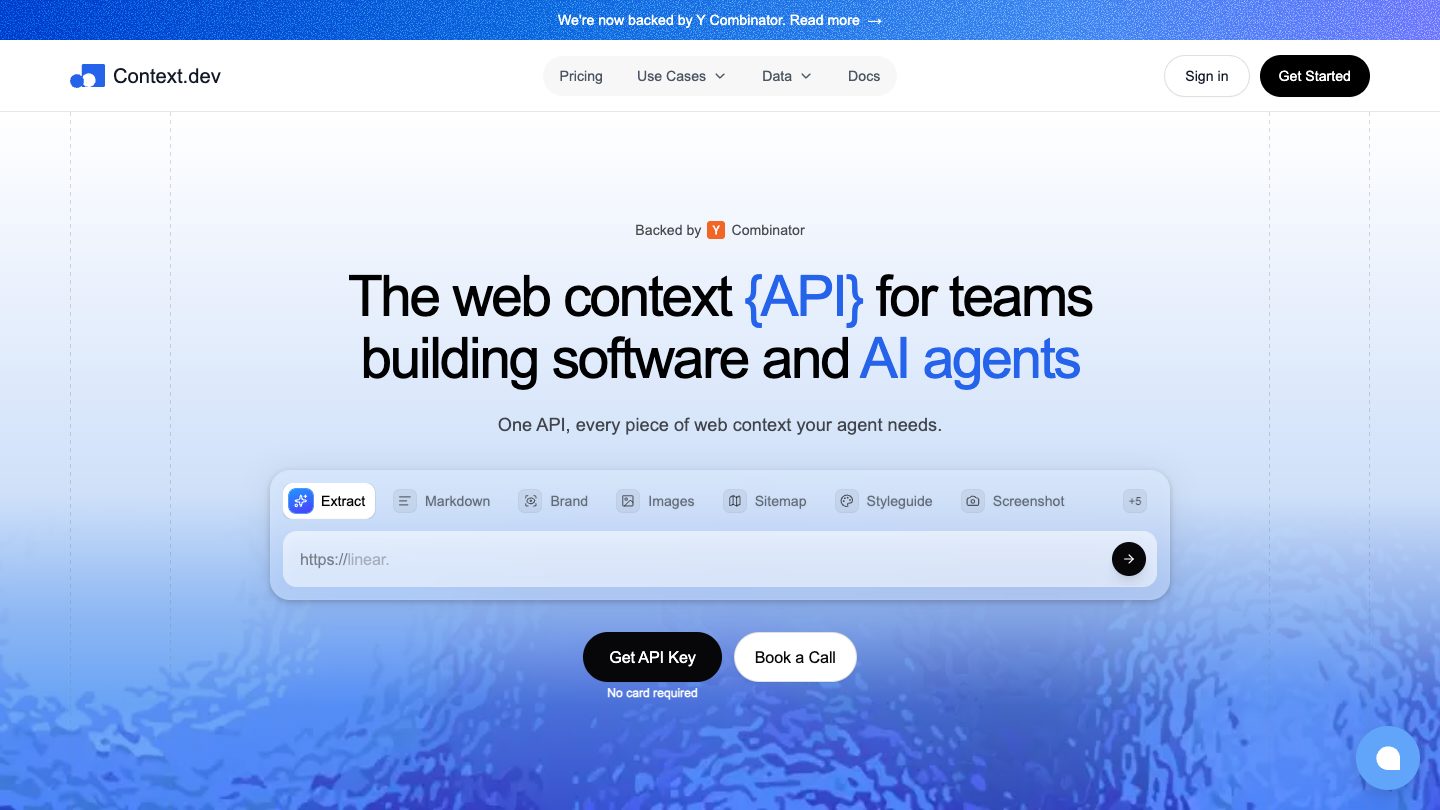
Context.dev is built by Yahia Bakour, a solo founder with prior exits at StockAlarm.io and essense.io, backed by Y Combinator's Summer 2026 batch. Founded in 2025 in San Francisco, the product evolved from Brand.dev — an API that fetched brand data (logos, descriptions, industry classification) when a user signed up with a corporate email — into Context.dev after customers asked for screenshots, structured extraction, and LLM-ready data formats.
The core function is straightforward: submit any URL and receive clean markdown for LLMs, rendered HTML, screenshots, extracted images, brand data (logos, colors, fonts, social links), or custom JSON extraction based on a schema you define. The platform handles PDFs, OCR, DOCX, PPT, and XLSX automatically. It respects robots.txt, includes a caching layer to avoid hammering websites, and offers stealth scraping as a built-in feature rather than a surcharge. SDKs are available for TypeScript, Python, and Ruby. Rate limits scale from 1 call per second on the free tier to 20 calls per second on the Scale plan. SOC 2 Type I certified. Confirmed customers include Mintlify, Daily.dev, Similarweb, and Chatwoot.
AnySearch — The Privacy-First Multi-Vertical Search
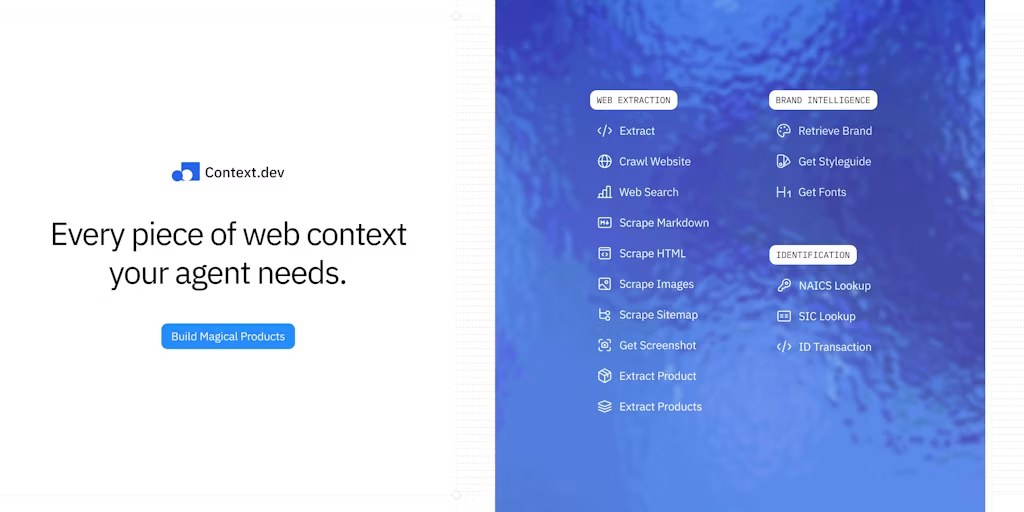
AnySearch launched in May 2026 as search infrastructure for AI agents. It is not a URL fetcher. It is a search engine that accepts a query, understands its intent, routes it to the appropriate vertical data sources — finance, academia, code, security, business, medical, patents, energy, environment, agriculture, travel, gaming, and more — and returns merged, ranked, structured results as JSON. Each result carries an authority score, a diversity score, and a freshness score. There are no links to inspect; the API returns usable data directly.
The privacy architecture is a genuine differentiator: zero retention execution, zero-knowledge credentials, no tracking, no telemetry, and no logging. Benchmark accuracy is reported at 76.4% overall across three datasets (Frames, FreshQA, WebwalkerQA) using z-ai/glm-5.1 as the evaluation LLM. End-to-end agent latency is 47.8 seconds in internal benchmarks. SOC 2 Type 2 compliant. Available through GitHub, skills.sh, ClawHub, SkillHub, and Glama developer ecosystems. The free tier offers 1,000 requests per day with a 20 QPS rate limit. The Search Pro plan is listed as "Coming Soon."
Head-to-Head Comparison
| Feature | Context.dev | AnySearch | Firecrawl |
|---|---|---|---|
| Core Function | URL → structured data | Query → multi-vertical search | URL → markdown/structured data |
| Use Case | Fetch & extract specific pages | Search across domains by topic | Crawl and extract at scale |
| Free Tier | 500 credits (no CC) | 1,000 requests/day (no CC) | 500 credits (no CC) |
| Starting Paid Price | $25/month | "Coming Soon" (Pro) | $16/month |
| Backing | YC S26 | Independent | Y Combinator |
| Customers | 5,000+ businesses | Not disclosed | Large ecosystem |
| SOC 2 | Type I | Type 2 | Type 2 |
| Latency | Not published | 47.8s end-to-end | Variable |
| Accuracy Benchmark | Not published | 76.4% (vendor-reported) | Not published |
| Privacy | robots.txt compliant | Zero retention, no logging | Standard compliance |
| Brand Intelligence | YES — unique feature | NO | NO |
| Vertical Domains | NO — URL-specific | YES — 12+ domains | NO |
| SDKs | TypeScript, Python, Ruby | API only | Multiple languages |
The comparison table makes the positioning clear. Context.dev is optimized for developers who know the URL and need the data extracted, cleaned, and structured. AnySearch is optimized for developers who have a query and need the system to find the most relevant information across specialized domains. Firecrawl sits in the middle as the established incumbent for URL-to-markdown extraction, but Context.dev differentiates with brand intelligence and transparent pricing, while AnySearch occupies a unique position with multi-vertical search and privacy-first architecture. Updated July 2026.
What Makes Each One Unique
Context.dev: Brand Intelligence Layer
No competitor in the web data extraction space offers a dedicated brand intelligence API. Context.dev returns logos, colors, fonts, style guides, company metadata, and NAICS classification alongside the scraped content. For CRM enrichment, onboarding flows, and ad generation, this is not a nice-to-have — it is a separate product category that Context.dev bundles into the same API call.
AnySearch: Privacy-First by Architecture
Zero retention execution, zero-knowledge credentials, and a explicit no-logging policy are not marketing claims — they are architectural decisions. In a category where every search query becomes training data for someone else's model, AnySearch's privacy stance is a genuine competitive advantage for security-conscious teams and compliance-heavy industries.
Context.dev: Transparent Pricing
"1 credit = 1 scrape, no hidden credit multiplier." This is a direct response to Firecrawl's pricing model, where credits can multiply based on page complexity. The founder's claim that every switching customer halved their bill is unverified but directionally consistent with the transparent pricing structure. The $25/month entry point is also lower than many competitors.
AnySearch: Intent-Based Vertical Routing
AnySearch does not just search the web — it understands query intent and routes to the appropriate vertical domain. A query about pharmaceutical patents routes to the patents and medical domains. A query about energy policy routes to energy and environment. This intent-based routing is the difference between a generic search API and a domain-aware research assistant.
Pricing & Plans
| Plan | Context.dev | AnySearch |
|---|---|---|
| Free | 500 credits (250 personal email, 500 work email) · 30 req/min · No credit card | 1,000 requests/day · 20 QPS rate limit · Community support · Structured outputs |
| Starter / Pro | $25/month · Scraping + brand data + basic extraction | Coming Soon · Search Pro — higher quality, more requests, deeper vertical search |
| Scale / Enterprise | 2M+ credits/month · SSO/SAML · SCIM · uptime SLA · annual invoicing · MSA/DPA · Contact: hello@context.dev | Custom limits · enterprise-grade rate limits · enterprise security/privacy/compliance · dedicated account manager · Contact Sales |
Pros & Cons
✓ Context.dev — Strengths
- ✅ Unique brand intelligence API — logos, colors, fonts, company metadata
- ✅ Transparent 1-credit-per-scrape pricing with no hidden multipliers
- ✅ 5,000+ confirmed business customers including Mintlify and Daily.dev
- ✅ YC S26 backing with proven founder track record (two prior exits)
✗ Context.dev — Limitations
- ❌ Not a search tool — requires you to already know the URL
- ❌ No published accuracy or latency benchmarks
- ❌ No mention of IP rotation or residential proxies on the homepage
✓ AnySearch — Strengths
- ✅ 12+ vertical domains with intent-based routing — unique in the category
- ✅ Privacy-first architecture: zero retention, zero-knowledge, no logging
- ✅ Generous free tier: 1,000 requests per day with no credit card
- ✅ SOC 2 Type 2 certified with published benchmark methodology
✗ AnySearch — Limitations
- ❌ 47.8-second end-to-end latency is high for real-time applications
- ❌ "Search Pro" plan still "Coming Soon" — only free tier is fully available
- ❌ 76.4% accuracy is vendor-reported with proprietary evaluation LLM — not independently verified
Who Should Use Which
Use Context.dev if: You are building an AI agent that needs to read specific web pages — customer websites for chatbots, GitHub repos for documentation, academic journals for research, or corporate sites for CRM enrichment. You need brand data (logos, colors, fonts) for onboarding flows or ad generation. You want custom JSON extraction based on schemas you define. You need a production-ready API with 5,000+ customers and clear pricing. You are frustrated with Firecrawl's credit multipliers and want transparent per-scrape billing.
Use AnySearch if: You are building an AI agent that needs to search across multiple vertical domains — finance, academia, code, legal, medical — and return structured, ranked results. You need privacy-first search with zero logging and zero retention. You work with GitHub coding agents that need to search code repositories alongside web content. You want a generous free tier for evaluation before committing to a paid plan. You value domain-aware routing over generic web search.
Use both if: Your agent workflow requires both discovery and extraction. Use AnySearch to find the relevant pages across vertical domains, then use Context.dev to extract clean markdown, brand data, or custom JSON from the specific URLs AnySearch discovered. This is the most common production pattern for sophisticated AI agents in 2026 — one tool for finding, one tool for fetching.
💡 Community Feedback
Learning Curve
Context.dev is designed for rapid integration. The quickstart at docs.context.dev/quickstart gets most developers from signup to first successful scrape in under ten minutes. The SDKs for TypeScript, Python, and Ruby are actively maintained, and the API structure is intuitive: send a URL, specify the output format, receive structured data. The brand intelligence and custom JSON extraction features add complexity only if you need them — the basic markdown extraction is a single API call. The free tier of 500 credits with no credit card requirement makes evaluation frictionless. For teams migrating from Firecrawl, the learning curve is nearly flat since the API patterns are similar.
AnySearch requires a different mental model. Instead of pointing at a URL, you formulate a query and trust the system to route it to the right vertical domains. The intent-based routing means you need to understand how AnySearch categorizes queries — a skill that takes a few hours of experimentation. The 47.8-second end-to-end latency means AnySearch is not suitable for real-time chatbot responses; it is designed for research and agent workflows where a few seconds of delay are acceptable. The free tier of 1,000 requests per day is generous enough for thorough evaluation. The lack of SDKs means you interact through raw API calls, which adds a small integration overhead compared to Context.dev's polished SDK experience. Updated July 2026.
Expert Editorial Opinion
The most important thing to understand about Context.dev and AnySearch is that they are not competitors. They are adjacent tools solving adjacent problems in the AI agent data stack. Context.dev occupies the extraction layer — the part of the stack that turns a known URL into usable data. AnySearch occupies the discovery layer — the part that turns a query into a set of relevant URLs and structured results. In a mature agent architecture, both layers are necessary. The question is not which one to choose. The question is which one to choose first.
Context.dev's technical execution is strong for a YC-stage company. The brand intelligence feature is genuinely unique — no other web scraping API we have evaluated offers dedicated logo, color, and font extraction as a first-class API endpoint. The transparent pricing model (1 credit = 1 scrape) is a direct and effective competitive weapon against Firecrawl, where credit multipliers have been a consistent source of customer frustration. The founder's track record — two prior exits, ex-Amazon, ex-Sunrun — adds credibility that many solo-founder YC companies lack. The 5,000+ customer base, confirmed through public customer logos, is substantial for a product that launched its current form in 2026.
AnySearch's technical positioning is more ambitious and less proven. The multi-vertical search with intent-based routing is a hard problem that has defeated many previous attempts. The 76.4% accuracy benchmark is promising but vendor-reported, and the 47.8-second latency is a genuine limitation for real-time use cases. Where AnySearch excels is in privacy architecture and vertical coverage. The zero-retention, zero-logging policy is not just a compliance checkbox — it is a product feature that opens doors in regulated industries where standard search APIs are non-starters. The 12+ vertical domains, if maintained with quality, create a moat that generic search APIs cannot cross.
The pricing gap analysis favors Context.dev for immediate production use. At $25 per month with a clear upgrade path, Context.dev is priced for teams that need to ship this week. AnySearch's free tier is more generous (1,000 requests per day versus 500 credits), but the "Coming Soon" Pro plan creates uncertainty for teams that outgrow the free tier. For a team running a production agent that needs both discovery and extraction, the combined cost would be approximately $25–$50 per month for Context.dev plus whatever AnySearch eventually charges for Pro — a reasonable stack cost for most AI agent projects. For teams choosing only one tool, the decision depends on whether their bottleneck is finding information or extracting it.
Is either tool worth adopting without a permanent free tier? Context.dev's 500-credit free tier is sufficient for evaluation and light production use, and the $25 entry point is low enough that most teams can justify the cost after a successful pilot. AnySearch's 1,000-request-per-day free tier is even more generous, but the absence of a published Pro price means teams cannot budget for scale. The honest answer is that both tools are worth evaluating on their free tiers, but Context.dev is the safer bet for production deployment today because its pricing is published, its customer base is proven, and its feature set is complete. AnySearch is the higher-upside bet for teams that need multi-vertical search and privacy guarantees — but it requires patience while the Pro plan and independent benchmarks arrive.
Final Verdict
Context.dev and AnySearch are not fighting for the same budget line item. Context.dev is the winner for RAG pipelines, CRM enrichment, brand data extraction, and any workflow where you know the URL and need the data. It is production-proven, transparently priced, and backed by a founder with a track record of shipping. AnySearch is the winner for multi-domain research, privacy-first search, and any workflow where your agent needs to discover information across finance, academia, code, or legal domains rather than fetch a specific page.
The honest answer for most developers building AI agents in 2026 is that you will eventually need both. AnySearch for discovery. Context.dev for extraction. Firecrawl remains the safe incumbent if you want a single vendor with the largest ecosystem, but Context.dev's brand intelligence and transparent pricing make it the better choice for teams hitting Firecrawl's credit multiplier pain points. AnySearch is the bet to make if multi-vertical, privacy-first search is a core requirement — but only if you can tolerate the current limitations around latency and unannounced Pro pricing.
🔗 Related ToolRadar Reviews
More tools from AI Developer Tools
- The Browser Automation API That Reads the Web for You
- I Built a Real Mac App From a Chat Prompt
- I Built a Production AI Agent in 10 Minutes
- I Gave an AI Agent Full Control of My Codebase
- I Replaced My Brittle Playwright Tests With AI
- I Controlled Claude Code With My Voice
- I Built an AI Agent Army Without Writing a Single Line of Code
- Beyond the Hype: Google ADK 2026 AI Agent Framework
❓ Frequently Asked Questions
Is your AI agent still searching the web like a human — or has it learned to think in layers?
Context.dev and AnySearch prove that the future of agent data is not one tool that does everything. It is a stack where discovery and extraction each get the specialist they deserve. The question is whether your architecture is built for that future yet.

Comments
Post a Comment