



Unstructured.io Review 2026: The Open-Source ETL Tool Turning Messy PDFs Into Clean LLM Data
60+ document types, 40+ source connectors, 15 million pages per hour, and a 40% reduction in RAG hallucinations. Is Unstructured the missing piece in your document pipeline?
- What Is Unstructured.io and Why Does RAG Need It?
- Core Features: From PDF Partitioning to MCP Integration
- Pricing Breakdown: Free Forever to Enterprise VPC
- Pros & Cons: Where Unstructured Shines and Stumbles
- Community Feedback: What Engineers Actually Say
- Unstructured vs LlamaParse vs AWS Textract: The 2026 Comparison
- Who Should Use Unstructured — and Who Should Skip It
- Expert Editorial Opinion
- Final Verdict
- Related ToolRadar Reviews
- Frequently Asked Questions
Here is the dirty secret Brian Raymond will tell you straight: data scientists still build artisanal, one-off data connectors and pre-processing pipelines completely manually. Every new PDF, every new Word document, every new PowerPoint deck that lands in an enterprise inbox requires someone to write custom code to extract text, identify tables, handle headers, and format everything into something an LLM can actually reason about. Raymond knows this because he lived it — first in the U.S. intelligence community, then at the CIA, then at Primer AI, where he and his co-founders Matt Robinson and Craig Wolfe repeatedly hit the same bottleneck. In 2022, they started Unstructured.io to solve it once and for all.
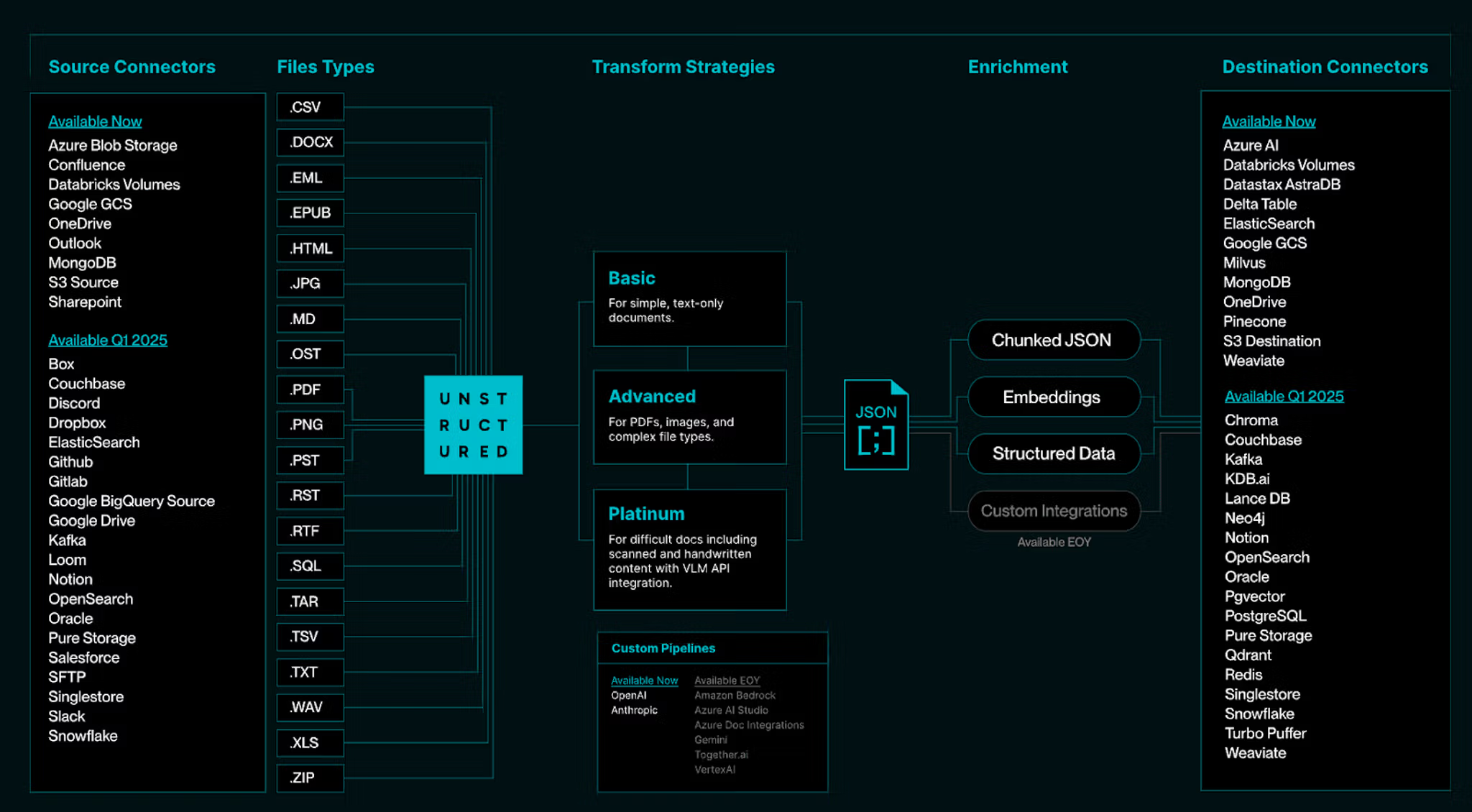
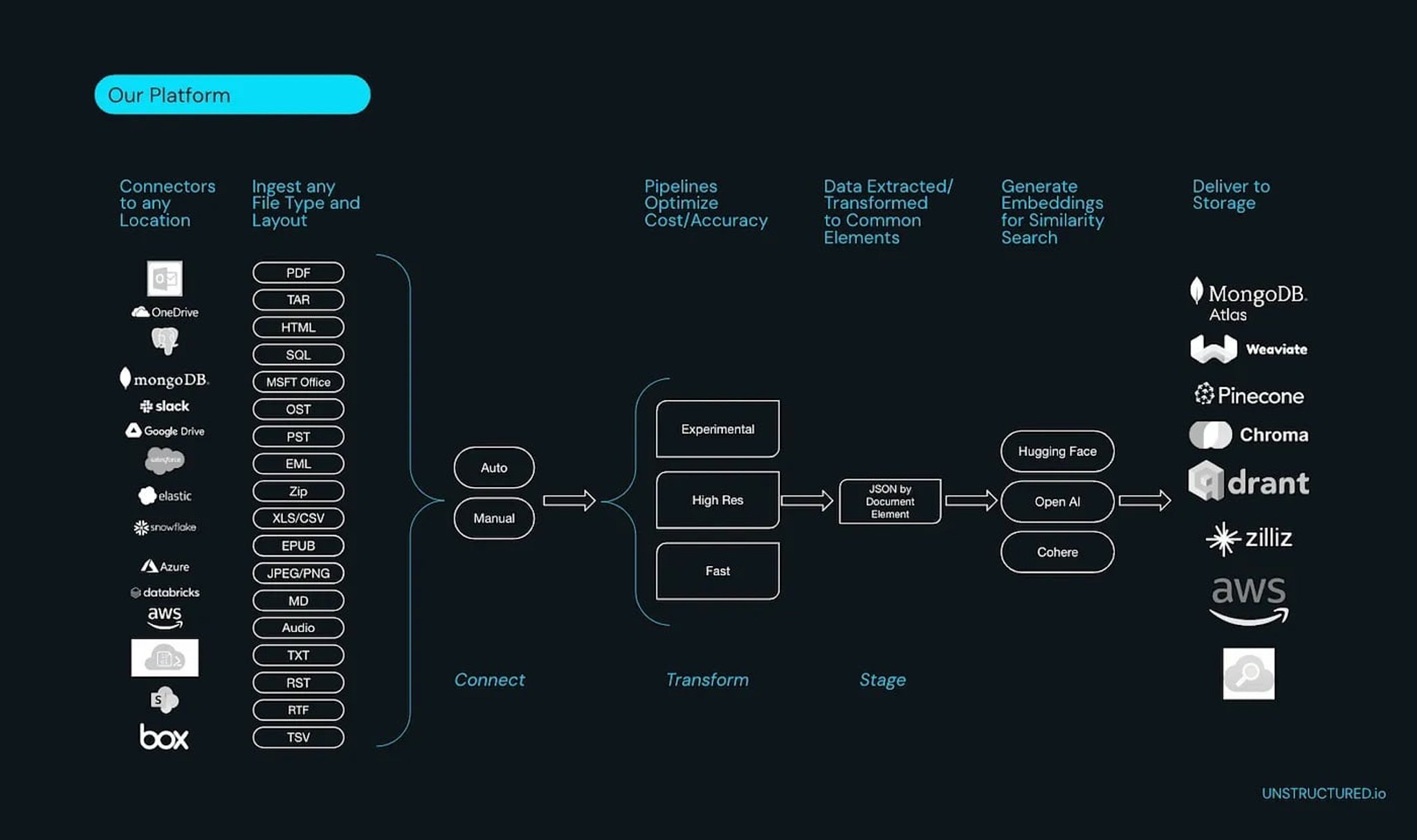
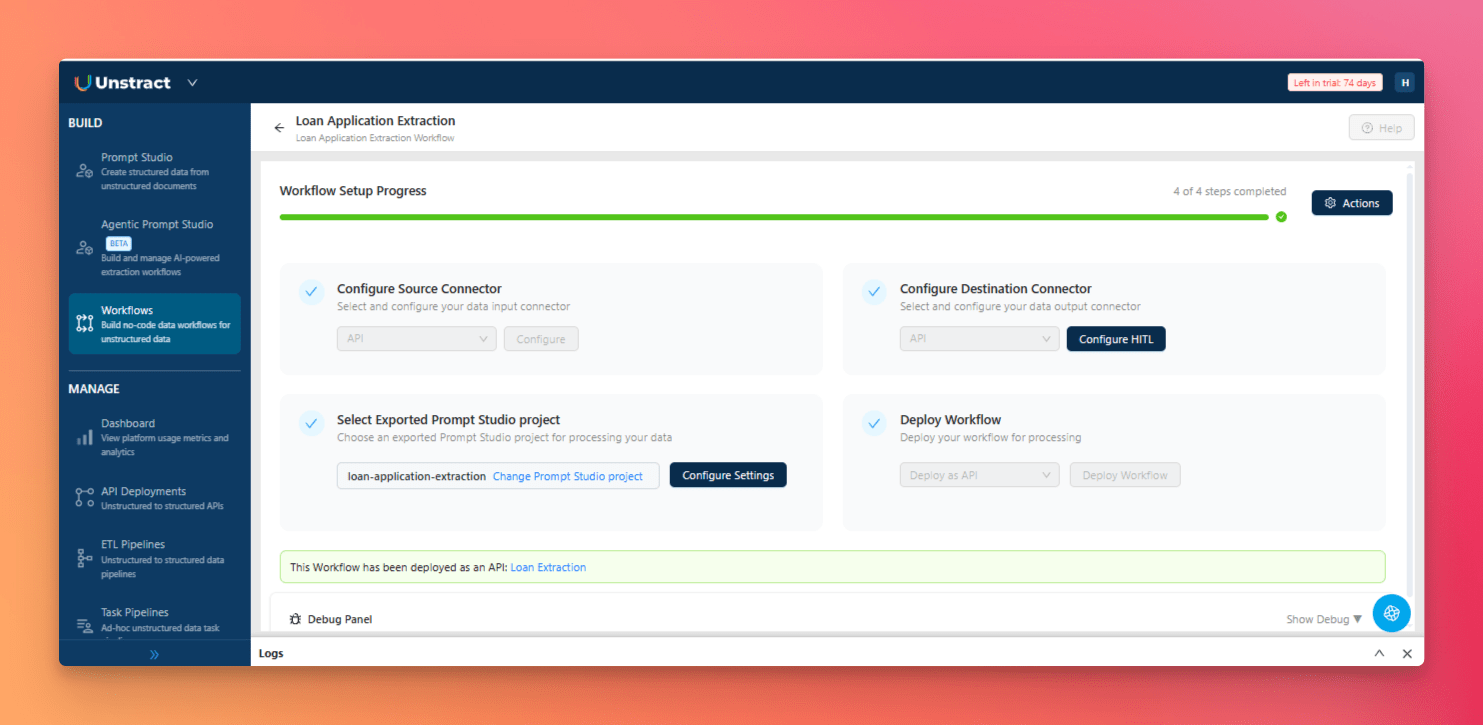
The platform has since become the closest thing the RAG world has to a default document-ingestion standard. It converts complex documents — PDFs, HTML, Word, PowerPoint, images, and over 60 other formats — into clean, structured data ready for LLM and RAG pipelines. It loads from 40+ sources including S3, Gmail, and Jira; partitions each file into logical elements like Title, NarrativeText, Table, ListItem, and PageBreak; enriches with layout ML for table boundaries, header detection, and image OCR; and outputs JSON, Markdown, HTML, or Arrow with coordinates, page numbers, languages, and SHA hashes. It processes 15 million pages per hour while maintaining 99.99% uptime. Updated July 2026, this review examines whether Unstructured.io lives up to its status as the RAG pipeline's backbone, or whether newer tools like LlamaParse have already surpassed it.
What Is Unstructured.io and Why Does RAG Need It?
Unstructured.io is an open-source ETL platform purpose-built for the document chaos that precedes every successful RAG implementation. The core insight is simple but widely ignored: most document-to-LLM pipelines fail not because the embedding model is weak or the vector database is slow, but because the input data is garbage. A PDF with scrambled table rows, a PowerPoint where bullet points get concatenated into run-on sentences, or a scanned image where OCR missed every third word — these are the real killers of RAG accuracy.
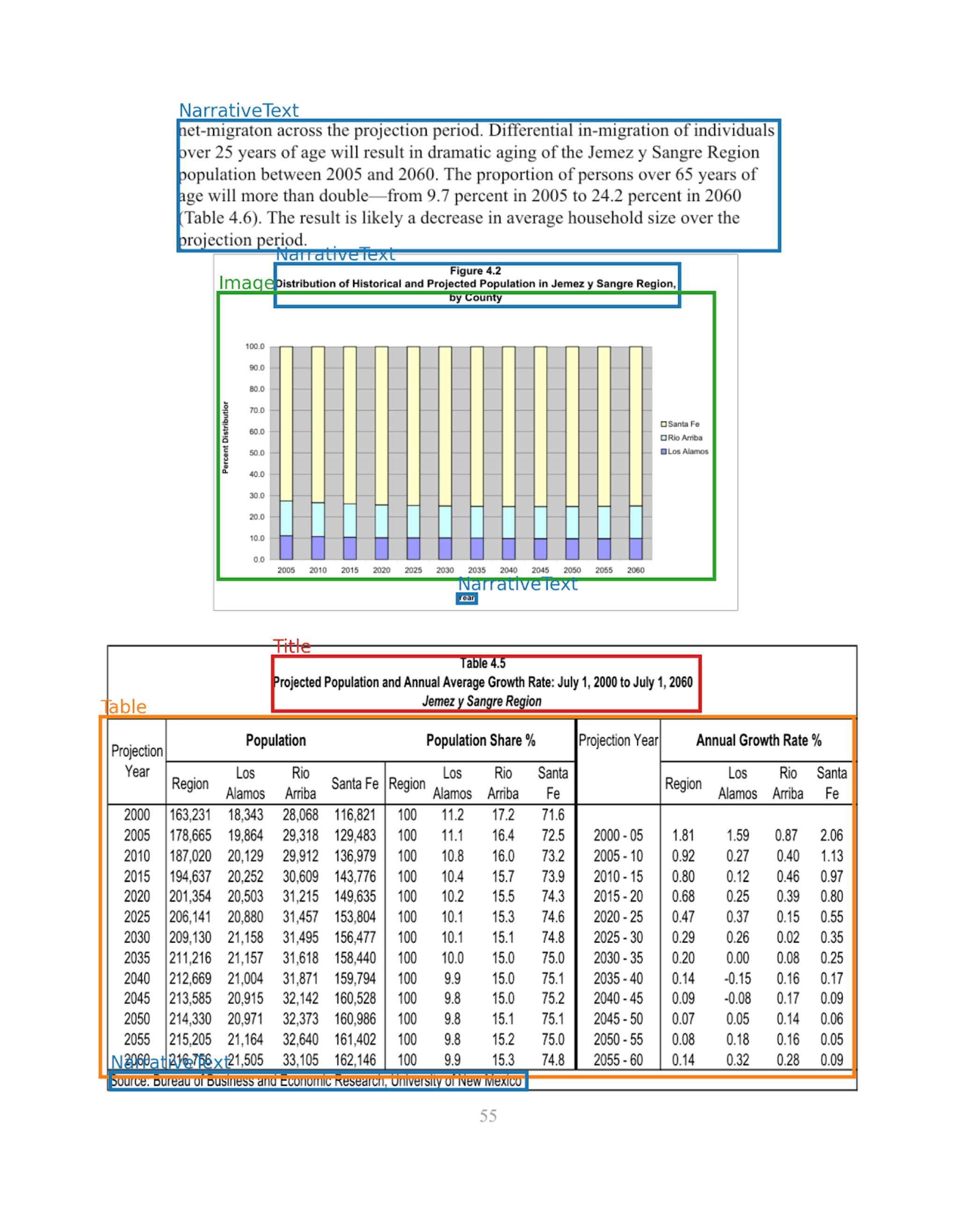
Unstructured addresses this through a hybrid approach combining rules and machine learning models to extract text with structural awareness. Rather than dumping everything into one undifferentiated text blob, it classifies each element — Title, NarrativeText, Table, ListItem, Header, Footer, PageBreak — preserving the document's semantic hierarchy. This matters because an LLM reading "Table 4.5: Projected Population Growth" as a narrative paragraph will hallucinate relationships that do not exist, while an LLM that knows it is looking at a table will reason about rows and columns correctly.
The platform offers two partitioning strategies. FAST uses pdfminer plus heuristic chunking and processes documents in seconds, ideal for bulk ingestion where speed matters more than perfection. HI-RES calls a dedicated layout model for page-accuracy, slower and GPU-optional, but essential for documents where table boundaries, header detection, and image OCR quality determine whether the downstream RAG pipeline returns facts or fiction. A real production test documented by the Neural Blueprint Substack reported a 40% reduction in hallucinated KPIs when using HI-RES partitioning with table inference compared to a plain pdfminer pipeline.
Core Features: From PDF Partitioning to MCP Integration
Intelligent Document Partitioning
Partitions documents into logical elements — Title, NarrativeText, Table, ListItem, Header, Footer, PageBreak — preserving semantic hierarchy. Two strategies: FAST (pdfminer + heuristics, seconds per doc) and HI-RES (dedicated layout model, GPU-optional, page-accurate). The difference can mean a 40% reduction in RAG hallucinations on table-heavy documents.
40+ Source Connectors
Load documents from filesystem, S3, Azure Blob, Google GCS, OneDrive, Gmail, Jira, Confluence, MongoDB, SharePoint, and more. The breadth of connectors means you are not writing custom ingestion scripts for every new data source — a genuine time-saver for enterprise pipelines with scattered document repositories.
MCP & Agent Integration
Full API access enables Model Context Protocol (MCP) integrations, unlocking direct natural language interaction between LLMs and document ETL pipelines. New image-to-text, text-to-text, and text-to-embedding models are added weekly, making the platform increasingly agent-friendly on top of an already mature ETL core.
Layout ML & OCR Enrichment
Enriches extracted elements with layout ML for table boundaries, header detection, and image OCR. Outputs include coordinates, page numbers, detected languages, and SHA hashes for data integrity verification. For scanned documents and complex layouts, this enrichment layer is the difference between usable data and digital noise.
Scale & Reliability
Processes 15 million pages per hour with 99.99% uptime. SOC 2 Type 2 certified, HIPAA compliant, and GDPR-ready. For enterprises processing regulatory filings, clinical documents, or legal contracts at scale, these numbers are not marketing — they are contractual requirements.
Flexible Output Formats
Outputs structured data as JSON, Markdown, HTML, or Apache Arrow — each with coordinates, page numbers, languages, and SHA hashes. This flexibility means Unstructured fits into any downstream pipeline, whether you are feeding a vector database, a data lake, or a custom RAG orchestrator.
Pricing Breakdown: Free Forever to Enterprise VPC
| Plan | Cost | What's Included |
|---|---|---|
| Open Source | $0 (Open Source) | Full core library, no restrictions, self-hosted, community support. No auth, no scheduling, no monitoring — you manage everything. |
| Platform/API (Starter) | 15,000 free pages | 15,000 free pages with no expiration, full access to every feature, pay-only-for-what-you-process with no minimums or commitments |
| Platform/API (Paid) | Pay per page | Beyond 15K pages, pay per page processed. No monthly minimums, no maximums, no annual contracts. Scales with usage. |
| Business | Custom pricing | Dedicated VPC deployment, multi-user access, dedicated support, SLA guarantees, custom integrations, HIPAA/GDPR audit support |
The pricing model is refreshingly straightforward. The open-source library is completely free with no feature restrictions — a genuine gift to the community from a team that understands the pain of building document pipelines from scratch. The Platform/API tier offers 15,000 free pages with no expiration date and full access to every feature, which is enough for most teams to evaluate the service thoroughly before committing. Beyond that, you pay only for what you process with no minimums, maximums, or commitments — a rare honesty in an industry that loves to trap users in annual contracts.
The Business tier adds dedicated VPC deployment for enterprises that cannot let document data leave their infrastructure, multi-user access for team collaboration, and dedicated support with SLA guarantees. Given Unstructured's unusual ties to government and defense agencies — a product of CEO Brian Raymond's background in the U.S. intelligence community and the CIA — the VPC option is not a nice-to-have for some customers; it is a requirement.
Pros & Cons: Where Unstructured Shines and Stumbles
✓ What Unstructured Gets Right
- ✅ Open-source core is genuinely free with zero feature restrictions
- ✅ 60+ document types and 40+ source connectors cover virtually any enterprise data source
- ✅ HI-RES partitioning with layout ML delivers 40% fewer hallucinations on table-heavy documents
- ✅ 15 million pages per hour throughput with 99.99% uptime for production-scale pipelines
- ✅ SOC 2 Type 2, HIPAA, and GDPR compliance for regulated industries
- ✅ MCP integration makes the platform increasingly agent-friendly for AI-native workflows
- ✅ 15,000 free pages with no expiration — one of the most generous free tiers in the ETL space
✗ Where It Falls Short
- ❌ Open-source library lacks auth, scheduling, monitoring, and image extraction — not production-ready alone
- ❌ For complex PDFs with tables, LlamaParse currently outperforms due to vision-based layout analysis
- ❌ HI-RES partitioning requires GPU and is significantly slower than FAST mode
- ❌ Managing dependencies (Poppler, Tesseract) and infrastructure is a real operational burden
- ❌ No incremental data loading means re-processing entire document sets on every run
💡 Community Feedback: What Engineers Actually Say
Unstructured vs LlamaParse vs AWS Textract: The 2026 Comparison
| Feature | Unstructured.io | LlamaParse | AWS Textract |
|---|---|---|---|
| Document Types | 60+ formats | PDF-focused | PDF, images, forms |
| Open Source | Yes — full core library | No — proprietary | No — AWS service |
| Table Extraction | Strong (HI-RES layout ML) | Best-in-class (vision-based) | Good (form tables) |
| Source Connectors | 40+ (S3, Gmail, Jira, etc.) | Limited | AWS-native only |
| Output Formats | JSON, Markdown, HTML, Arrow | Markdown, JSON | JSON, CSV, text |
| Pricing Model | Free OSS + pay-per-page | Pay-per-page | Pay-per-page + AWS fees |
| Enterprise Compliance | SOC 2, HIPAA, GDPR, VPC | Basic compliance | AWS compliance suite |
| Best For | Multi-format enterprise RAG | PDF-heavy, table-rich docs | AWS-native form processing |
The comparison reveals three distinct philosophies. Unstructured.io optimizes for breadth — the ability to handle virtually any document format from virtually any source with a unified pipeline. LlamaParse optimizes for depth — extracting the maximum possible accuracy from PDFs, particularly table-heavy ones, using vision-based layout analysis. AWS Textract optimizes for integration — if you are already in the AWS ecosystem and processing forms or invoices, it is the path of least resistance.
For most RAG pipelines, the choice is between Unstructured and LlamaParse. If your documents are diverse — PDFs mixed with Word docs, PowerPoints, emails, and images — Unstructured's breadth wins. If your documents are predominantly complex PDFs with tables, charts, and multi-column layouts, LlamaParse's vision-based approach will likely deliver better extraction quality. Many production teams actually use both: Unstructured as the general-purpose ingestion layer and LlamaParse as a specialized preprocessor for the most complex PDFs.
Who Should Use Unstructured — and Who Should Skip It
Ideal users: Teams building RAG pipelines that need to ingest diverse document types into clean, structured data for LLM consumption. Data science teams at enterprises with scattered document repositories across S3, SharePoint, Gmail, and Jira. Legal tech startups processing contracts, briefs, and regulatory filings in mixed formats. Financial services firms ingesting annual reports, 10-Ks, and research PDFs where table accuracy directly impacts downstream analysis. Healthcare organizations handling clinical notes, discharge summaries, and imaging reports with strict HIPAA requirements. Any team that has ever written a custom PDF parser and sworn never to do it again.
Look elsewhere if: You only process simple text files or have minimal document variety — a basic text splitter will suffice. If your documents are exclusively complex PDFs with dense tables, LlamaParse's vision-based extraction will likely outperform Unstructured's layout ML. If you need production-grade scheduling, monitoring, and authentication out of the box, the open-source library will disappoint; use the paid Platform/API instead. If you are deeply embedded in AWS and only process forms or invoices, Textract's native integration may be simpler. And if you have no ML engineering resources to manage dependencies like Poppler and Tesseract, the operational burden of self-hosting the open-source version may exceed its value.
Expert Editorial Opinion
Unstructured.io occupies a unique position in the AI tooling ecosystem: it solves a problem so fundamental that most teams do not even recognize it as a problem until they have spent weeks building custom parsers. The "dirty secret" Raymond describes is real — I have seen data science teams at Fortune 500 companies spend more engineering hours on document ingestion than on model training. Unstructured's value proposition is not that it does something no one else can do; it is that it does something everyone needs, and does it well enough that building a custom solution is no longer justifiable.
The pricing gap between the open-source library and the Platform/API is the most important strategic decision for potential users. The open-source version is genuinely powerful — the same partitioning logic, the same format support, the same output formats. But it is explicitly not designed for production, and the documentation is refreshingly honest about this. No auth, no scheduling, no monitoring, no incremental loading, and the operational burden of managing Poppler and Tesseract dependencies. For a proof-of-concept or a small-scale pipeline, the open-source version is perfect. For anything approaching production scale, the Platform/API's managed infrastructure, 99.99% uptime, and compliance certifications are worth the per-page cost.
The 15,000 free pages with no expiration is one of the most generous free tiers in the ETL space. It is not a 14-day trial or a credit that expires — it is 15,000 pages you can use whenever you want, however you want. This confidence in the product's value speaks volumes. Teams can integrate Unstructured into their pipeline, process real documents, measure the quality improvement, and make an informed decision about whether to pay for more pages. There is no lock-in pressure, no feature-gated teaser — just a genuinely useful free tier that converts users through quality rather than scarcity.
The LlamaParse comparison is where Unstructured's limitations become visible. For table-heavy PDFs, LlamaParse's vision-based approach consistently outperforms Unstructured's layout ML. This is not a fatal flaw — Unstructured handles 60+ formats while LlamaParse is PDF-focused — but it is a real gap that teams processing financial reports, scientific papers, or regulatory filings should account for. The pragmatic approach is to use Unstructured as the general-purpose ingestion layer and route the most complex PDFs through LlamaParse as a specialized preprocessor. This hybrid architecture is increasingly common in production RAG pipelines.
One final consideration: Unstructured's government and defense ties, born from Raymond's intelligence community background, are a double-edged sword. On one hand, they explain the platform's emphasis on security, compliance, and VPC deployment — features that matter enormously to regulated industries. On the other hand, they may raise questions for teams in jurisdictions with strict data sovereignty requirements or for organizations with policies against vendor ties to defense agencies. This is not a criticism of the platform's technical merits, but it is a factor that procurement and legal teams may weigh differently depending on their context.
Final Verdict
Unstructured.io earns an 8.5 out of 10 for its exceptional breadth of format support, genuinely free open-source core, and proven impact on RAG accuracy — the documented 40% reduction in hallucinations on table-heavy documents is not marketing fluff; it is a real production outcome. The platform has earned its status as the default document-ingestion standard for a reason: it solves a universal problem with a solution that scales from a solo developer's laptop to a Fortune 500's VPC. The 0.5-point deduction comes from the open-source library's explicit non-production limitations, the table-extraction gap versus LlamaParse on vision-based PDFs, the GPU requirement for HI-RES mode, and the operational burden of managing dependencies for self-hosted deployments. For any team building a RAG pipeline that ingests more than one document type, Unstructured.io belongs in your architecture — either as the primary ingestion layer or as the foundation you build specialized preprocessors on top of.
🔗 Related ToolRadar Reviews
More tools from Data Processing & AI
- Can Humata AI Actually Read a 500-Page PDF?
- The Search Engine Built for AI Agents
- I Summarized a 50-Page Paper in 5 Minutes — Here's the Tool
- I Turned a 47-Page Research Paper Into a Presentation
- I Replaced 3 Hours of Code Reading With This AI Tool
- Can AI Really Edit Your Video Like a Pro?
- Your AI Agents Have Security Holes — This Tool Fixes Them
- I Gave AI a 47-Page Spec and Watched It Build the App
❓ Frequently Asked Questions
How many hours has your team spent writing custom PDF parsers this quarter?
The best RAG pipeline in the world is only as good as the data you feed it — and most teams are still feeding it garbage they extracted by hand.

Comments
Post a Comment