


Can Kuberns Really Deploy Your App to AWS in 5 Minutes With Zero Config?
The only cloud deployment platform where an AI agent reads your repository, figures out your framework and configuration by itself, provisions infrastructure on AWS, and gives you a live HTTPS URL — without a single YAML file, DevOps form, or manual configuration step. 40% cheaper than raw AWS. Free to start.
Updated July 2026 · Independent review based on official documentation and verified user feedback
Every developer who has tried to deploy a full-stack app to AWS knows what actually happens: you spend 45 minutes on IAM roles, another hour on VPC configuration, you write a docker-compose.yml that works locally and breaks in production, you debug an ECS task definition that fails silently, and somewhere around hour four you're reading a Stack Overflow answer from 2019 that may or may not apply to your situation. This is not a skill problem. This is a configuration overhead problem — and it affects every developer who just wants their code live, not a DevOps certification.
Kuberns is an AI-powered cloud Platform as a Service (PaaS) that eliminates that entire configuration loop. The platform's agentic AI reads your GitHub repository, detects your stack and framework automatically — React, Next.js, Node.js, Python, Django, FastAPI, Flask, Laravel, Spring Boot — sets the build command and port configuration without asking you, provisions infrastructure on AWS, and returns a live HTTPS URL in under five minutes. No YAML files. No DevOps forms. No configuration steps. The AI does the thinking that usually takes hours or days. Kuberns runs the infrastructure at 40% less than raw AWS costs, with a 99.9% uptime SLA, across five global datacenter regions.
What Is Kuberns?
Kuberns is an AI-powered cloud PaaS that provides one-click deployment automation across AWS infrastructure — without requiring developers to configure build pipelines, containers, or cloud resources manually. The platform's core differentiator is its agentic AI layer: rather than a smart build detector that recognizes common frameworks and asks you to confirm, Kuberns' AI agent actually reads the repository, determines the stack, sets the configuration, and executes the deployment autonomously. The result is a live production environment — with HTTPS, autoscaling, monitoring, logs, CI/CD pipeline, and secrets management — in under five minutes, for any supported framework. The platform handles full-stack orchestration: frontend, backend, databases, and background workers within a single unified deployment workflow. Built-in monitoring provides logs and performance metrics without external tooling. Continuous optimization manages scaling and resource adjustments based on application usage. Zero Platform Fees means developers pay only for underlying cloud resource consumption — not a per-seat license or a fixed monthly platform charge on top.
Key Features
Agentic Stack Detection & Auto-Deploy
The AI agent reads your GitHub repository, identifies the framework, build command, runtime, and port automatically — without prompts, forms, or configuration files. Connect your repository and Kuberns handles the rest. Particularly powerful for vibe-coded apps where the stack may be mixed or non-standard.
Zero Config CI/CD Pipeline
Connect a Git repository and every subsequent push triggers an automated build-test-deploy cycle without defining infrastructure, build steps, or configuration files. Build history, rollback, and environment promotion (development → staging → production) are managed automatically.
Built-In Monitoring
Real-time server monitoring, detailed metrics, logs, and build history are included natively — no external Datadog, CloudWatch, or Grafana setup required. Traffic filtering identifies threats automatically. Autoscaling responds to load without manual intervention.
5-Region Global Infrastructure at 40% Less Than AWS
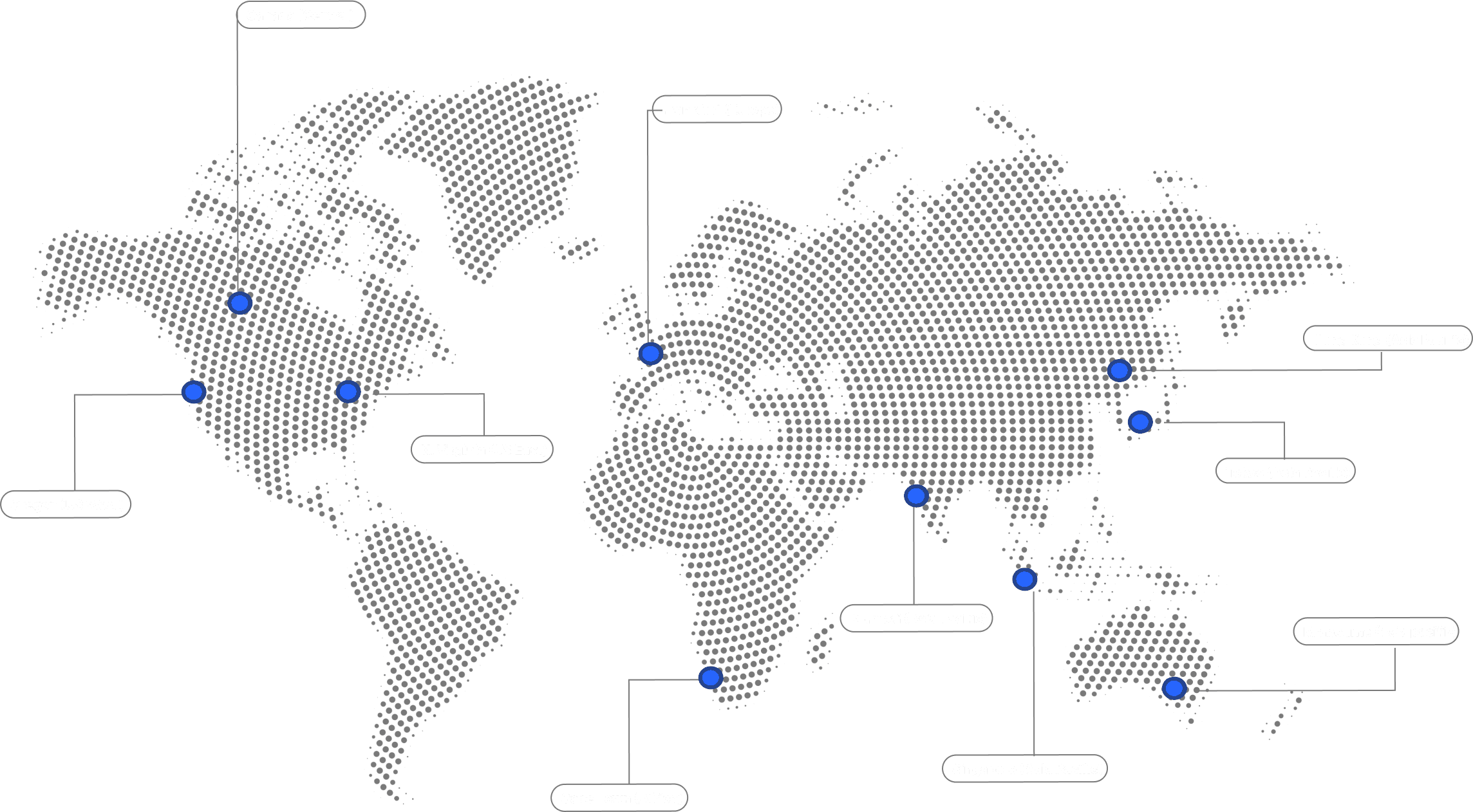
Kuberns provisions infrastructure on AWS across five global datacenter locations, with deployment automation across all geo-regions for single or multi-region deployments. The platform's cost efficiency comes from infrastructure optimization — customers report 40–90% reductions in cloud costs compared to managing AWS directly.
Pricing Plans
| Plan | Price | What's Included |
|---|---|---|
| Free Trial | Available at kuberns.com | Full platform access — agentic deployment, CI/CD, monitoring, autoscaling, secrets management — no time restriction on free tier features |
| Usage-Based | Starts at $20/month | Pay for underlying cloud resource consumption — no platform fees on top of usage; scale up or down based on actual workload |
| Growth | Custom | Teams needing multi-region deployment, higher concurrency, dedicated support |
| Enterprise | Custom | Large organizations — advanced access controls, audit logs, compliance, SLA, dedicated engineering support |
Note: Kuberns operates on a zero-platform-fees model — revenue comes from usage-based pricing on the underlying AWS infrastructure it provisions. All core features including environment management, scaling, secrets, and CI/CD are available in the free tier. Paid tiers reflect infrastructure consumption, not feature gating. Check kuberns.com/pricing for current plan details.
Deploy Your First App Free on Kuberns — Live in 5 Minutes →This review contains affiliate links. ToolRadar may earn a commission at no extra cost to you.
Pros & Cons
✓ What Works
- ✅ Agentic AI reads your repository — no configuration forms, no YAML, no DevOps knowledge required to deploy any supported stack
- ✅ 40% cheaper than raw AWS — infrastructure optimization delivers meaningful cost savings vs managing AWS infrastructure directly
- ✅ All core features free — environment management, scaling, secrets, CI/CD available on free tier with no time restriction
- ✅ Full-stack orchestration — frontend, backend, databases, and background workers in a single unified deployment workflow
✗ Where It Falls Short
- ❌ Bootstrapped, no disclosed funding — no Crunchbase or Tracxn record; company scale and long-term support commitment harder to verify than VC-backed alternatives
- ❌ Founding date and team not publicly disclosed — less transparency than competitors like Railway or Render who have clear founding stories and investor backing
- ❌ Cost savings claims (85–90%) come from customer testimonials on the Kuberns website — independent third-party verification of these figures is not yet available
- ❌ 5 datacenter locations — smaller geographic footprint than AWS, GCP, or Azure directly; latency-sensitive global deployments may need evaluation
💡 Community Feedback
How It Compares to Alternatives
| Feature | Kuberns | Railway | Render | Vercel |
|---|---|---|---|---|
| AI Stack Detection | YES — agentic, reads repo | PARTIAL — smart detect | PARTIAL — smart detect | YES (Next.js only) |
| Zero Config Deploy | YES — fully autonomous | PARTIAL | PARTIAL | PARTIAL |
| Full Stack (FE+BE+DB) | YES — unified | YES | YES | NO (frontend focus) |
| Starting Cost | Free + usage | Free + $5/mo | Free + usage | Free + $20/mo |
Railway and Render both provide smart build detection — they recognize common frameworks and help you configure your deployment. Kuberns' agentic AI goes further: it reads the repository and determines the configuration independently, without waiting for you to confirm settings. This distinction matters most for mixed-stack apps, vibe-coded projects with non-standard structures, and any situation where the developer doesn't want to make configuration decisions. Railway and Render are more mature platforms with longer track records and more transparent company profiles — both are strong choices. Kuberns' agentic deployment model is its specific differentiator. Vercel remains the best choice for Next.js frontends specifically, but lacks the full-stack orchestration that Kuberns provides out of the box.
Learning Curve
Kuberns has the shallowest learning curve of any deployment platform in its category. The entire onboarding flow consists of connecting a GitHub repository and clicking deploy — no configuration forms, no YAML files, no documentation required. A developer with zero DevOps experience can have a production app live in under five minutes. Compare this to Railway, which requires understanding service connections and environment variable wiring, or Render, which asks you to define build commands and instance sizes. Even Fly.io, while powerful, demands familiarity with Docker containers and CLI workflows. Kuberns removes every friction point that typically slows first-time deployment. The tradeoff is less granular control: if you need to customize build pipelines, tweak container settings, or manage infrastructure at the VM level, you will hit Kuberns' abstraction ceiling faster than on Railway or Fly.io. For the target user — developers who want to ship, not configure — this is a feature, not a bug.
Who Should Use Kuberns?
Best For: Solo developers, indie hackers, and startup teams (seed to Series A) who want to ship full-stack applications to production without a dedicated DevOps engineer. Vibe-coded project builders who generated their app with an AI tool and need a deployment platform that handles non-standard, mixed, or AI-generated stacks without manual configuration. Teams migrating from Heroku after its 2026 shift to sustaining engineering mode who need a modern, actively developed alternative. Engineering teams of 10–100 spending significant time on cloud configuration overhead that could be eliminated by an agentic deployment layer.
Consider Alternatives If: You need maximum infrastructure control and are comfortable with CLI-heavy workflows — Fly.io gives you more granular control at the cost of a steeper learning curve. You're deploying Next.js frontends and already deep in the Vercel ecosystem — Vercel's Next.js-specific optimization is unmatched for that use case. You need enterprise-grade compliance certifications (SOC 2 Type II, HIPAA, FedRAMP) with documented audit trails — evaluate Render's Business tier or AWS directly. You have a complex multi-cloud or hybrid cloud architecture requirement — Kuberns is AWS-only and not designed for multi-cloud orchestration.
Expert Editorial Opinion
Kuberns makes the correct distinction that most deployment platforms miss: auto-detection and agentic deployment are not the same thing. A smart build detector that recognizes Next.js from a package.json and fills in a configuration form is useful but not transformative — you're still confirming settings, still reviewing a deployment checklist, still making decisions. Kuberns' agentic AI reading the repository and figuring out the configuration independently is a fundamentally different interaction model. The developer connects a repository. The AI handles everything else. That distinction matters most for the fastest-growing segment of app builders in 2026 — vibe-coders who generated their app with Claude Code, Cursor, or Glaze and need a deployment platform that can handle whatever stack the AI builder produced.
The cost efficiency story is the most immediately compelling for budget-conscious teams, but it requires honest context. The 85–90% cost reduction figures come from customer testimonials on the Kuberns website — not independent audits. The more conservatively stated figure from the platform itself (40% cheaper than raw AWS) reflects the infrastructure optimization Kuberns provides versus a developer provisioning and managing equivalent AWS resources manually. For teams currently over-provisioning EC2 instances or running expensive managed services they don't fully utilize, the savings are real. For teams already running lean, optimized AWS infrastructure, the primary value is time savings on configuration and maintenance, not cost reduction.
The bootstrapped, undisclosed-founding-date question is the honest uncertainty in this review. Railway, Render, and Fly.io have clear founding stories, known investors, and years of community trust built in public. Kuberns' company profile is less visible — no Crunchbase record, no disclosed founding date, limited team transparency. The product works, customer testimonials are specific and credible, and the technical capability (agentic stack detection, full-stack orchestration, AWS infrastructure at scale) is real. But teams making infrastructure decisions that affect production applications should factor in platform longevity and support reliability when evaluating any bootstrapped deployment platform. For side projects, vibe-coded apps, and startup MVPs where switching costs are low, the risk is minimal and the productivity gain is significant.
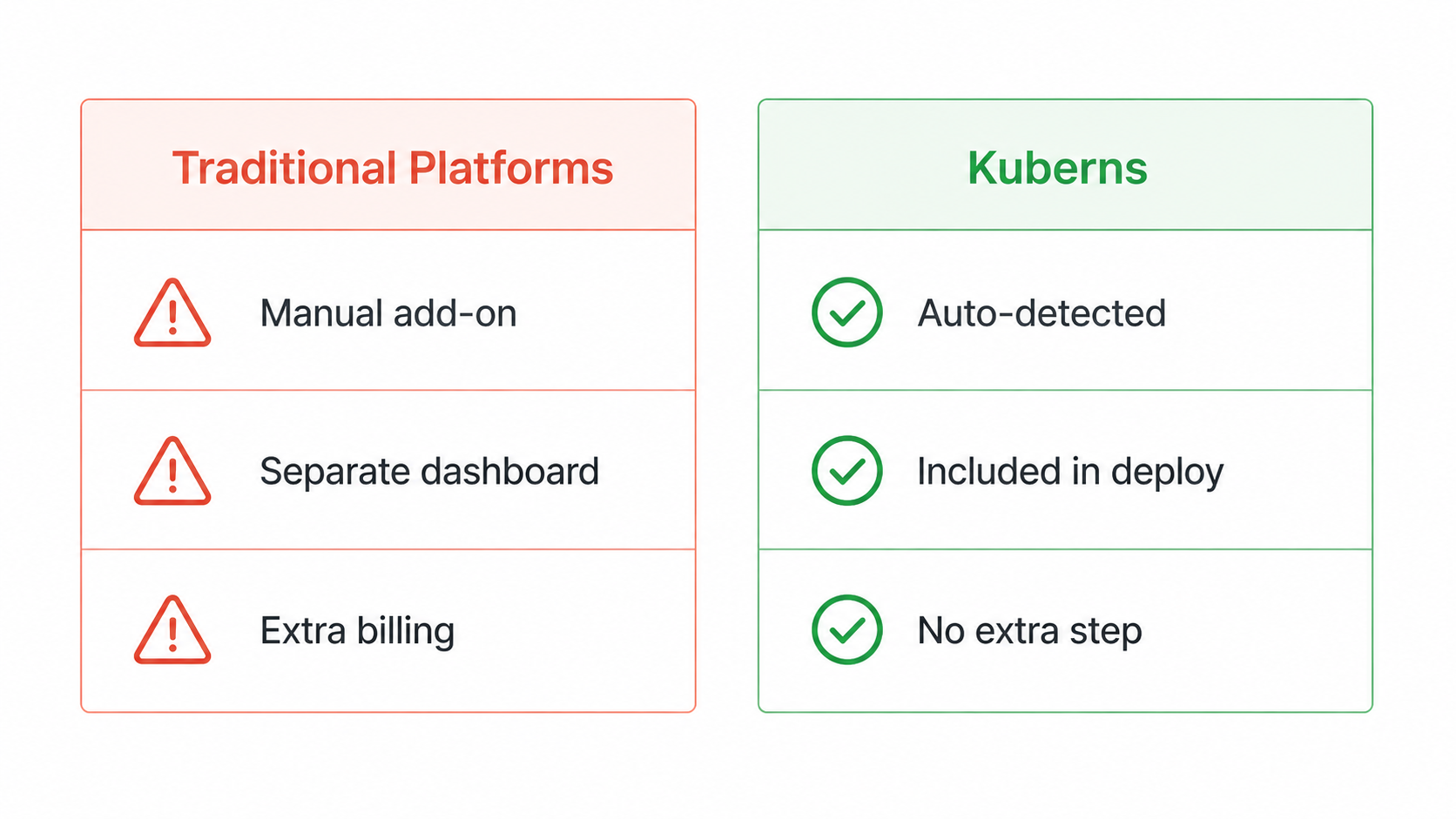
The pricing gap is worth examining closely. Kuberns' zero-platform-fees model means all core features — deployment, CI/CD, monitoring, autoscaling, secrets — are available on the free tier. Revenue comes from AWS resource usage, not feature gating. This is a genuinely user-friendly pricing structure that removes the typical PaaS pressure to upgrade for basic functionality. The $20/month starting point for paid usage is competitive with Railway's Hobby plan ($5/month minimum) and Render's Individual plan ($7/month per service). For a small full-stack app, Kuberns is likely the cheapest option when you factor in that monitoring, CI/CD, and autoscaling don't require paid upgrades.
Does Kuberns deserve a 9.1 without a free tier? The question is moot — Kuberns does have a free tier, and it's generous. The real question is whether a bootstrapped platform with limited public company information can sustain the infrastructure commitments it makes. The 99.9% uptime SLA, the AWS-backed infrastructure, and the specific customer testimonials all suggest the platform is operationally sound. The absence of VC backing is not inherently a weakness — it can mean slower growth but also more sustainable unit economics. For developers evaluating Kuberns, the recommendation is clear: start with a side project or MVP, validate the deployment experience and cost savings for your specific stack, and scale commitment as the platform proves itself. The 9.1 score reflects the technical capability and user experience, with the transparency caveat priced in.
Final Verdict
Kuberns is the most genuinely agentic cloud deployment platform available for developers in 2026. The AI agent that reads your repository and deploys without asking you to configure anything — for any supported framework, to AWS infrastructure, with monitoring and CI/CD included — is the correct implementation of AI-assisted deployment. The 40% cost efficiency, zero platform fees model, free tier with no time restriction, and 99.9% uptime SLA make the platform accessible and trustworthy for the use cases it targets. The bootstrapped company transparency gap is the honest caveat for teams making long-term infrastructure commitments. For developers who just want their code live — without a DevOps checklist, without YAML files, without a four-hour AWS configuration session — this is a 9.1 out of 10 and the fastest path from repository to production available today.
Technical Quality: 9.5/10 · Price-to-Value: 9.0/10 · Maturity & Documentation: 8.8/10
🔗 Related ToolRadar Reviews
More tools from AI Developer Tools
- Promptfoo Review 2026: Open-Source CLI for AI Testing & Evaluation
- LangWatch Review 2026: Open-Source LLM Observability Platform
- TruLens Review 2026: Free Open-Source LLM Evaluation Framework
- Modal Review 2026: $46.5B Serverless GPU Infrastructure Platform
- Arize AI Review 2026: Enterprise AI Observability Platform
- Jina AI Reader Review 2026: Free One-Line API for Web Content Extraction
- How I Cut LLM Debugging Time by 80% With One Open-Source Tool
- I Cut My AI Inference Costs by 50% Using One Open-Source Tool
❓ Frequently Asked Questions
Your Next App Is Already Built. What's Stopping You From Deploying It?
If an AI can read your repository and ship your code to production in five minutes, the only barrier left is the decision to start.
Comments
Post a Comment